
Lawson Disqualified From Mexico Qualifying After Self-Reported Power Breach
On this page7
- 01What did the stewards disqualify Lawson for?
- 02Why did self-reporting not save him?
- 03How did Lawson’s Saturday start, with the Verstappen apology?
- 04What does the disqualification mean for Sunday’s race?
- 05What is the MGU-K rampdown rule, and why is the FIA strict about it?
- 06Who else shaped the Mexico grid?
- 07What happens next?
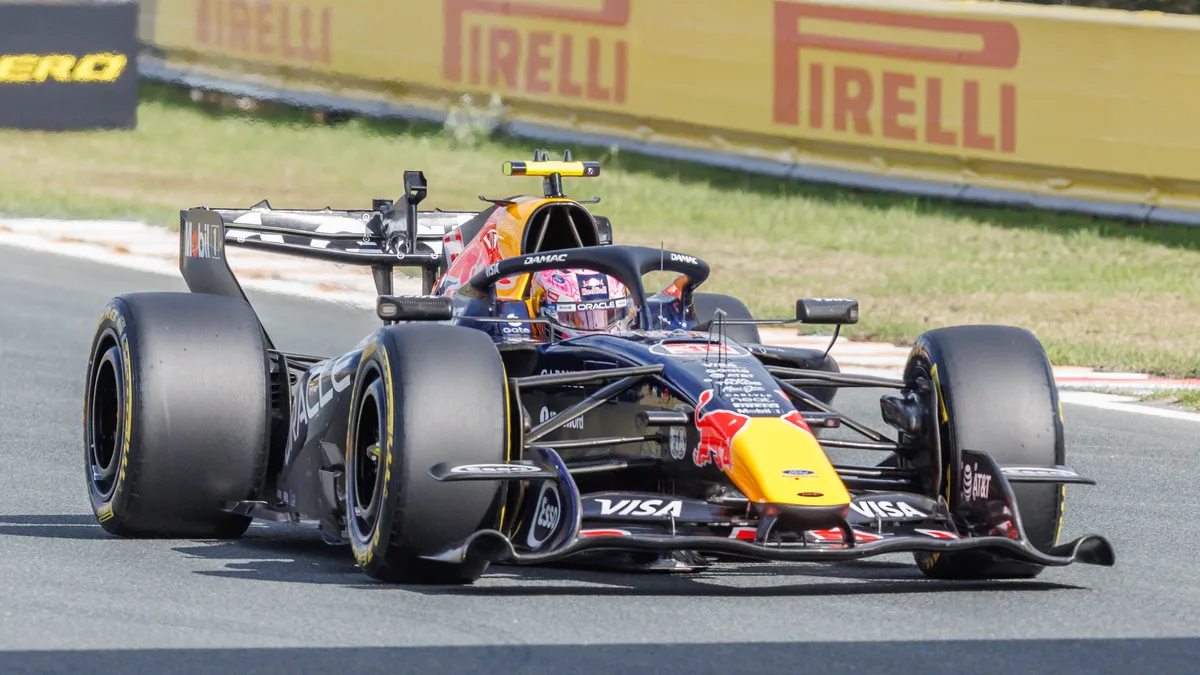
Liam Lawson qualified eighth in Mexico City, apologised to Max Verstappen in the morning, and will start Sunday’s race last. The stewards disqualified the Racing Bulls driver from Saturday’s qualifying session after his car breached the minimum MGU-K power requirement just after he crossed the line on his fastest Q2 lap, and the fact that his own team reported the breach did not save him. It is the harshest possible end to a weekend that had already gone wrong on Friday, and it turns Sunday into a recovery drive through a field Lawson had just outqualified.
What did the stewards disqualify Lawson for?
A power curve that fell too fast. The FIA technical delegate reported that Lawson was in breach of the minimum MGU-K power requirement just after crossing the line on his fastest lap in Q2, Formula 1 reports. The stewards’ decision, accepted by all parties present, said that after the control line at the end of that lap, Lawson did not lift off the power immediately, so the rate of reduction in MGU-K deployment did not achieve the regulated step down. In plain terms, the electrical power was supposed to taper off gradually and instead dropped away too steeply. That is a technical infringement, and for technical infringements the penalty is almost always the same: exclusion from the session.
Why did self-reporting not save him?
Because the rulebook does not grade technical breaches on intent. Racing Bulls disclosed the breach themselves, and the stewards noted that fact in particular, Formula 1 reports. The team argued the breach provided no performance advantage, and all parties at the hearing agreed with that, Autosport reports. The stewards answered with the line that now defines the case: non-compliance with the technical regulations is not excused if no performance advantage is gained, and a car must comply at all times during an event. Precedent, they said, requires disqualification where a car does not comply, despite all mitigating circumstances. Self-reporting earned Lawson honesty points. It earned him no grid slots.
How did Lawson’s Saturday start, with the Verstappen apology?
With an apology before the punishment. Lawson and Verstappen had collided in the stadium section during Friday’s second practice, damaging both cars and bringing out a brief red flag, Speedcafe reports. Both drivers received one-place grid penalties and a penalty point on their licences. On Saturday morning, before qualifying, Lawson went to see Verstappen to apologise. “I went to see Max this morning to apologise. Obviously, it was never my intention to make contact,” he told reporters, Grand Prix 247 reports. Verstappen had been critical of his former team-mate after the collision, questioning his judgement and suggesting such incidents were hardly helpful while Lawson fights for his Formula 1 future. Lawson refused to escalate it, and the apology closed the personal side of the incident hours before the technical side of his weekend fell apart.
What does the disqualification mean for Sunday’s race?
It rewrites Lawson’s weekend from promising to damage limitation. He had qualified eighth, ahead of team-mate Arvid Lindblad, with both Racing Bulls cars reaching Q3 in a closely fought session, Formula 1 reports. The one-place penalty for the Verstappen clash would have left him ninth. Instead he starts from the back of the grid, in a race where overtaking is possible but track position at the start is still precious. Speedcafe reports he will need the stewards’ permission to take part, which is routinely granted on practice times, and that Racing Bulls would face a pit-lane start instead if it changes his car in breach of parc ferme rules. Autosport adds the wider context: the disqualification is good news for Alpine, one of Racing Bulls’ rivals for fifth in the constructors’ championship, though Racing Bulls still hold a comfortable 33-point advantage.
What is the MGU-K rampdown rule, and why is the FIA strict about it?
It is the rule that stops teams gaming the end of a lap. Autosport reports the FIA clarified that Lawson ran out of battery power at the end of his flying lap, causing his MGU-K deployment to drop off completely and output to fall from 350kW to zero instantly. Article C5.12.6 of the technical regulations requires that reduction to happen gradually, capped at 50 or 100kW per second depending on the circuit. The sensitivity is not theoretical: the FIA intervened earlier this year to clamp down on alleged qualifying tricks employed by Mercedes and, to a lesser extent, Red Bull, Autosport reports, after teams found ways around the maximum rampdown rate. Lawson’s case was not deliberate, and the stewards accepted that. But a rule written to close a loophole cannot bend for an accident without reopening the loophole, which is why the FIA treats the rampdown rate as black and white even when the breach is innocent.
Who else shaped the Mexico grid?
Lewis Hamilton, at the front, and a familiar pattern at the back. Hamilton took pole position for the 105th time in his career and the first time in more than three years, NZ Sportswire reports, with George Russell missing out by 0.009 seconds. That is the headline Lawson’s disqualification pushed aside, and it frames Sunday as a race with a veteran on pole and a penalised young driver charging from the back. The weekend also continues a run of stewards’ interventions in Mexico that began with the Friday practice clash between Verstappen and Lawson, where both drivers were penalised and the paddock spent Saturday debating fault. The pattern is familiar from earlier in the season, when Hamilton apologised for his own strategy call in Singapore and when Russell was sent to the back of the grid in Singapore over an engine penalty, and it underlines how often 2026 grids have been set as much by the stewards’ room as by the stopwatch.
What happens next?
Sunday’s race, from the back, with the season’s wider arguments still running. Lawson’s recovery drive is the immediate story: how far a Racing Bulls car can climb through a midfield that includes the Alpine cars his disqualification helped. Beyond that, the case will feed the ongoing debate about technical rules that punish accidents as harshly as cheating, a debate that flared when Verstappen and Hamilton argued sprints should not run where cars cannot pass and when Antonelli’s title arithmetic became the sport’s talking point ahead of Austin. The stewards have made their point: disclose it yourself, gain nothing from it, and you still go to the back. That is a rule every team will remember the next time a power curve drops too fast.
Frequently asked questions
Why was Liam Lawson disqualified from Mexico City qualifying?+
For a technical breach on his fastest Q2 lap. The FIA technical delegate reported Lawson was in breach of the minimum MGU-K power requirement just after crossing the line, Formula 1 reports. The stewards found that after the control line, Lawson did not lift off the power immediately, so the rate of reduction in MGU-K deployment did not achieve the regulated step down. The disqualification removed him from the qualifying classification entirely.
Did Lawson gain an advantage from the breach?+
No, and that is the part that stings. All parties at the hearing accepted that Racing Bulls gained no sporting advantage, Autosport reports, and the team argued exactly that. The stewards answered that non-compliance is not excused by a lack of advantage, and that a car must comply with the technical regulations at all times during an event. Technical infringements are, as Autosport puts it, black and white.
What is the MGU-K rampdown rule?+
It governs how quickly a car must shed electrical power after a flying lap. Autosport reports the FIA clarified that Lawson ran out of battery at the end of his lap, so his MGU-K output fell from 350kW to zero instantly instead of stepping down gradually. Article C5.12.6 of the technical regulations caps the reduction at 50 or 100kW per second, depending on the circuit. The rule became a flashpoint earlier this year when the FIA clamped down on qualifying tricks it believed Mercedes and Red Bull were using.
Where would Lawson have started without the disqualification?+
Ninth. He qualified eighth, ahead of team-mate Arvid Lindblad, with both Racing Bulls cars reaching Q3, Formula 1 reports. He was already carrying a one-place grid penalty for his Friday practice collision with Max Verstappen, which would have dropped him to ninth. The disqualification replaces that with a start from the back of the grid.
What did Racing Bulls do when they found the breach?+
They told the FIA themselves. The stewards noted in particular that the team self-disclosed the breach, Formula 1 reports, and still imposed disqualification because precedent requires it for a car that does not comply with the technical regulations. Racing Bulls accepted the ruling, saying in a statement that no advantage was gained but that Lawson will start tomorrow's race at the back of the grid.
How did Lawson's weekend reach this point?+
Through a collision on Friday and an apology on Saturday. Lawson and Verstappen made contact in the stadium section during second practice, damaging both cars and bringing out a brief red flag, Speedcafe reports. Both drivers received one-place grid penalties and a penalty point. On Saturday morning Lawson went to see Verstappen to apologise, saying it was never his intention to make contact, and Verstappen had earlier questioned his former team-mate's judgement.
What does the disqualification mean for Sunday's race?+
A recovery drive from the back, with a complication attached. Speedcafe reports Lawson will need the stewards' permission to take part, which is routinely granted on practice times, and that Racing Bulls would face a pit-lane start instead if it changes his car in breach of parc ferme rules. Autosport notes the disqualification is a small opening for Alpine in the fight for fifth in the constructors' standings, though Racing Bulls still hold a 33-point cushion.
Who starts on pole in Mexico City?+
Lewis Hamilton, for the 105th time in his career and the first time in more than three years, NZ Sportswire reports, with George Russell missing out by 0.009 seconds. Lawson's misfortune is therefore not the only story at the front: Hamilton's return to pole position after such a long gap is the headline the disqualification pushed down the order.
Sources
- Formula 1: Lawson disqualified from Mexico City GP qualifying for technical breach (the MGU-K breach after his fastest Q2 lap, the stewards' reasoning, the self-disclosure, the back-of-grid start)
- Autosport: Lawson disqualified from F1 qualifying in Mexico, here's why (the 350kW to zero drop, Article C5.12.6, the no-advantage finding, the Alpine constructors' context)
- Speedcafe: Lawson disqualified from Mexico City qualifying (the FP2 collision with Verstappen, the Saturday apology, the pit-lane start risk)
- Grand Prix 247: Lawson disqualified from Mexico City Grand Prix qualifying after technical breach compounds Verstappen clash (the qualifying eighth, the summons wording, the apology quotes)
- NZ Sportswire: Liam Lawson to start back of grid at Mexican GP (Hamilton's 105th pole, Russell 0.009 seconds behind, Racing Bulls' acceptance statement)
Play & tools
Free browser games and tools — no account, no download.
- Play 24-0 — Draft an F1 chassis and two drivers, then chase a perfect 24-0 — win every race on the 24-round calendar.
- Explore all our games →
Related motorsport guides
View all →
Verstappen and Lawson Get Grid Penalties for 'Unacceptable' Mexico FP2 Clash
Max Verstappen and Liam Lawson made contact in the stadium section during Mexico FP2, causing a red flag and damage to both cars, and both were summoned by the stewards.
Liam Lawson Will Headline a Live Gig in Austin With His Childhood Band
Racing Bulls driver Liam Lawson will make his on-stage debut at the team's Austin Garage Sessions, playing a custom Taylor guitar with his brother and childhood bandmates.
Antonelli Takes COTA Pole With Title on the Line as FIA Clears Delta-Time Investigation
Kimi Antonelli took pole for the United States Grand Prix at Austin, where a win plus help from Russell and Hamilton would make him F1's youngest champion.
FIA to Investigate Software Glitch That Stopped F1 Cars on the Formation Lap in Malaysia
The FIA promised a full review after a software bug cut power to F1 cars on a wet formation lap at Sepang, forcing Hamilton to stop and restart his car.
Haas Drops Ocon for Hirakawa's F1 Debut in Mexico After Radio Row
Haas replaced Esteban Ocon with reserve driver Ryo Hirakawa for the rest of the Mexico City Grand Prix weekend, hours after Ocon's tyre dispute with his race engineer on Friday.
FIA Admits Human Error Gave Some Cars Extra Power in Singapore Sprint Qualifying
The FIA says a Race Control human error switched Overtake Mode on for 27 seconds in Singapore SQ1, giving some cars extra power, and Sainz wants to know why.