
How to Keep Score in Golf: Reading and Marking a Scorecard

On this page5
To keep score in golf, count every stroke you take on a hole — including penalty strokes — and write that number in the hole’s box on the scorecard, then add the boxes for your nine-hole and eighteen-hole totals. The player with the fewest total strokes wins. That is stroke play, the format almost everyone starts with.
The card looks busier than it is. Once you know which row is yours and what the yardage, par, and handicap rows mean, marking a round takes seconds per hole. Here is how to read it and record a clean score.
How do you actually mark a scorecard?
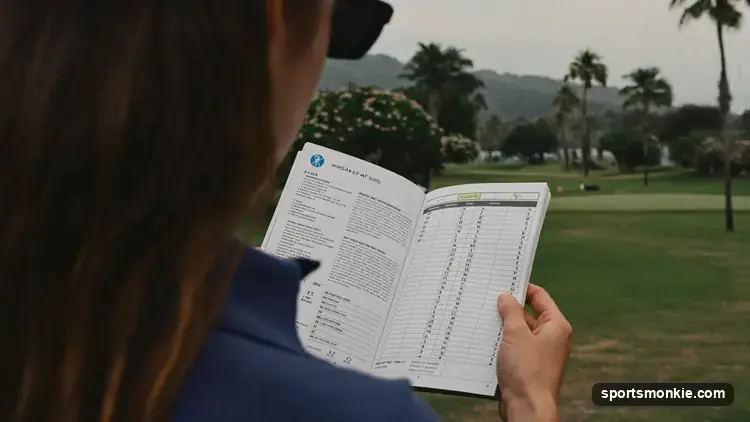
Each hole gets one box in your row. After you hole out, count your strokes — every swing that was meant to hit the ball, plus any penalty strokes for a lost ball or water — and write the total. A par 4 you completed in five swings is a 5. Nothing more complicated than that.
Traditionally you mark a playing partner’s card, not your own, and they mark yours; you confirm each other’s totals at the end. In casual golf most people just keep their own. Either way, write the number as soon as you finish the hole, while it is fresh — reconstructing “was that a six or a seven?” three holes later is where scores go wrong.
Reading the rows on the card
A scorecard is a grid. Holes 1 to 18 run across the top; the rows underneath tell you everything about each hole.
| Row on the card | What it tells you |
|---|---|
| Hole | The hole number, 1 through 18 |
| Yardage (by tee) | Length from each tee box — black, blue, white, red |
| Par | Expected strokes for a scratch golfer (3, 4, or 5) |
| Handicap / Index / Stroke | How the hole ranks in difficulty, 1 (hardest) to 18 (easiest) |
| Your score row | The blank boxes where you write your strokes |
The handicap row matters once you play net golf: it decides which holes you receive your handicap strokes on. On a hole indexed 1 through your course handicap, you subtract a stroke from your gross score to get your net score for that hole.
Gross score, net score, and the terms you will hear
Your gross score is the raw total of strokes. Your net score is gross minus your course handicap, which lets players of different abilities compete fairly. Alongside the totals, golfers describe individual holes with these terms:
| Term | Meaning | Example on a par 4 |
|---|---|---|
| Eagle | Two under par | 2 |
| Birdie | One under par | 3 |
| Par | Even with par | 4 |
| Bogey | One over par | 5 |
| Double bogey | Two over par | 6 |
If you are new, do not worry about birdies — worry about writing an honest number in every box. Our guide to what is a good golf score puts those totals in context, and bogey in golf explains the most common result on a beginner’s card.
Formats that change how you score
Stroke play is the default, but the same round can be scored three ways, and they are not marked identically:
- Stroke play — total every stroke; lowest total wins. This is what feeds your handicap.
- Match play — you win, lose, or halve each hole. The card tracks holes “up” or “down” rather than a running stroke total; a match can end before the 18th.
- Stableford — you earn points per hole against a fixed target (2 points for par, 3 for birdie, 1 for bogey, 0 for double or worse). A blow-up hole costs you points, not your whole card, so it keeps casual rounds moving.
Agree the format on the first tee. Nothing derails a friendly round faster than two players marking the same card under different rules.
The one rule beginners should use: cap the hole
You do not have to hole out every disaster. Under the World Handicap System, the maximum score you post for handicap purposes is a net double bogey — par plus two, plus any handicap strokes you get on that hole. For casual play, a simpler version is to pick the ball up at double par and write that number. According to the USGA, this cap keeps pace of play reasonable and stops one wet hole from wrecking an otherwise decent card. Once you are recording legitimate scores this way, you have everything you need to establish a handicap — our guide to determining your handicap in golf is the next step.
Frequently asked questions
How do you keep score for beginners?+
Count one stroke every time you swing at the ball, plus any penalty strokes, and write the total in the box for that hole. Add the boxes for a nine-hole and eighteen-hole total. Beginners can cap each hole at double par to keep the round moving; this is called a maximum score and keeps your card readable.
How to keep score in a golf game?+
In standard stroke play you record actual strokes per hole and the lowest total wins. In match play you win, lose or halve each hole and track holes up or down instead of a total. Stableford awards points per hole against a target score. Agree which format you are playing before the first tee so everyone marks the card the same way.
What is the 70/30 rule?+
The 70/30 rule is a practice guideline, not a scoring law: spend about 70 percent of practice time on the short game inside 100 yards and 30 percent on the full swing. It reflects where scores are actually made — most golfers lose the majority of their strokes to chips, pitches and putts, not driving distance.
What is the 90 percent rule?+
The 90 percent rule usually refers to golf carts, not scoring: the 90-degree rule lets carts drive on the fairway only at a right angle from the path to your ball, limiting turf wear. In handicap terms, a separate allowance system reduces a player's full course handicap in some competition formats to keep them fair.
Sources
Play & tools
Free browser games and tools — no account, no download.
- Play today's Sports Connections — Today's Sports Connections — daily hints, answers, and play the grid.
- Play Guess the NFL Player — A new mystery NFL player every day. Eight guesses, with a clue on each — plus free unlimited mode.
- Explore all our games →
Related golf guides
View all →
Wolf Golf Game Rules: How to Play and Score
Wolf golf game rules: how the Wolf rotates, picks a partner or goes Lone Wolf, plus a simple points scoring system and 3-man Wolf explained.

What Is a Condor in Golf? The Rarest Score in the Sport
A condor is four under par on one hole: a hole-in-one on a par 5. Fewer than ten have ever been recorded. Here are the confirmed condors.
What Is a Good Golf Score? Benchmarks by Skill & Age
A good golf score is anything under 90 on a par-72 course, which beats about 75% of players. See the benchmarks by skill level and age, for 9 and 18 holes.

What Is Par in Golf? Score, Hole Ratings, and Course Par
Par is the score a skilled golfer is expected to need for a hole, nine, or full course under normal conditions.
What Is a Hole-in-One in Golf?
A hole-in-one is a score of one stroke on a par-three, par-four or par-five hole, although the hole's official par and format still matter.

12 Golf Putting Tips to Sink More Putts and Cut Your Score
The best golf putting tips start with setup: eyes over the ball, a quiet lower body, and distance control. Here are 12 simple putting tips to hole more short putts and three-putt less.