
Best Sports Bikes: Top Motorcycles for Performance Riders
On this page6
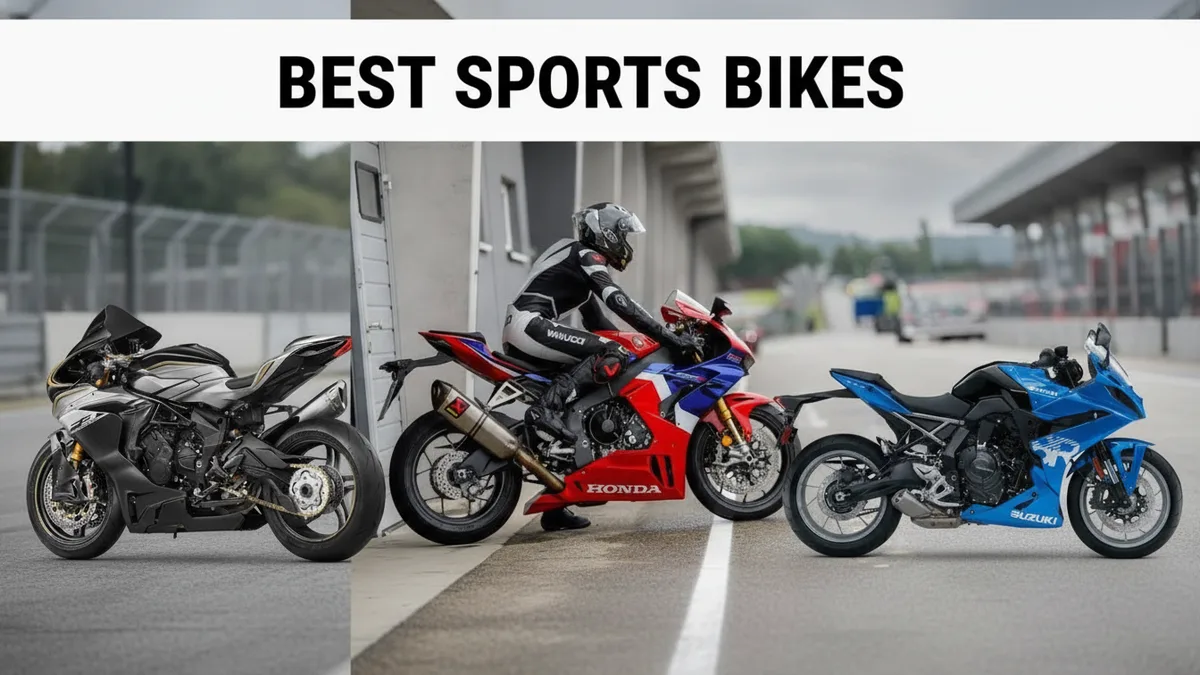
The best sports bikes span two very different worlds. At one end sit learner-friendly 300–400cc machines like the Kawasaki Ninja 400 and Yamaha YZF-R3, built to teach new riders control. At the other end are litre-class superbikes such as the Ducati Panigale V4 and Honda CBR1000RR-R Fireblade SP, whose electronics were developed in MotoGP. The right choice depends on your experience, budget, and intended use far more than on brand loyalty.
For off-road racing history rather than road-bike buying advice, see our ranking of the greatest motocross riders of all time. Readers comparing racing disciplines can also explore MotoGP versus Formula 1 and the riders with the most MotoGP championships.
How sports bikes are categorised
Sports bikes are broadly grouped by engine displacement and intended use:
- Supersports (300–500cc): Entry-level bikes with learner-friendly power and genuine handling credentials.
- Middleweight sports (600–900cc): Lighter and more technically demanding, requiring rider skill to extract their performance.
- Litre-class superbikes (1000cc+): The pinnacle of road-legal performance, with enormous power and racing-derived electronics.
Standout litre-class superbikes
Yamaha YZF-R1 / R1M — The R1’s crossplane inline-four gives it a sound and mid-range delivery unlike its four-cylinder rivals. The R1M adds Ohlins electronic suspension for near-top-tier track capability. As of 2026 it remains on sale in the US, though Yamaha has moved it to track-only status in Europe under Euro 5+ rules.
Honda CBR1000RR-R Fireblade SP — Honda’s flagship was redesigned to chase outright track pace, carrying racing-derived aerodynamics, an Ohlins package, and a deep electronics suite that holds its own against the class.
Ducati Panigale V4 — The Panigale runs a MotoGP-derived V4, giving it a different character from the inline-fours around it: more exotic, more expensive, and backed by factory race support. Ducati quotes the 2026 Panigale V4 R at roughly 318 km/h.
Kawasaki Ninja ZX-10R — Few bikes carry as many World Superbike titles. It trades a little outright edge for an approachable chassis, which is part of why track-day riders often pick it as their first superbike.
Standout middleweight and entry bikes
Yamaha YZF-R9 — Yamaha’s 890cc CP3-powered supersport now anchors the middleweight class, effectively succeeding the discontinued street R6 with modern electronics and emissions compliance.
Yamaha YZF-R7 — A friendlier 689cc twin that bridges the gap between small-displacement bikes and full supersports, popular as a step-up machine.
Honda CBR600RR — Honda’s 600cc flagship pairs smooth, high-revving power with precise handling, a touch friendlier day to day than the outgoing R6.
Kawasaki Ninja 400 — Repeatedly cited as one of the best beginner sports bikes ever built. It handles like a bike a class up, stays light through corners, and gives new riders room to improve before they outgrow it.
Yamaha YZF-R3 — Packs real sports bike handling into a smaller, lighter package, a common first rung on the ladder toward an R9 or R1.
Key sports bike specifications compared
| Model | Displacement | Approx. power | Target rider |
|---|---|---|---|
| Yamaha YZF-R3 | 321cc | Entry-level | Beginner |
| Kawasaki Ninja 400 | 399cc | Moderate | Beginner–intermediate |
| Yamaha YZF-R7 | 689cc | Moderate–high | Intermediate |
| Honda CBR600RR | 599cc | High | Intermediate–advanced |
| Yamaha YZF-R9 | 890cc | High | Intermediate–advanced |
| Honda CBR1000RR-R SP | 999cc | Very high | Advanced |
| Yamaha YZF-R1M | 998cc | Very high | Advanced |
| Ducati Panigale V4 | 1103cc | Very high | Advanced |
What to look for when choosing a sports bike
Electronics: Modern superbikes offer traction control, cornering ABS, wheelie control, and multiple riding modes. These systems improve safety and let riders extract more with less risk.
Ergonomics: Sports bikes favour forward weight bias and committed riding positions. Do a test sit and confirm you can manage the posture before committing to a model.
Intended use: A bike that shines on track can be punishing in traffic. If the bike will see heavy road use, a middleweight or sports-touring derivative may balance comfort and pace better.
Running costs, sizing, and care
Sports bikes reward regular upkeep. Litre-class machines often carry short valve-check intervals that can be costly, so factor servicing into the purchase decision. Chain lubrication, tyre condition, and coolant checks matter more here than on relaxed commuters, since sustained high revs stress the whole drivetrain. On sizing, ergonomics scale with the rider: shorter riders may struggle to flat-foot taller superbikes, while committed clip-on bars load the wrists in slow traffic. A proper test sit, matched to your inseam and reach, prevents an expensive mismatch, and quality gear — helmet, back protection, and armoured jacket — is non-negotiable given the performance on tap.
Frequently asked questions
What is the fastest production sports bike?+
The track-only Kawasaki Ninja H2R, with its supercharged 998cc engine and roughly 310 hp, is widely cited as the fastest production motorcycle at around 400 km/h (249 mph). Among street-legal machines, most litre-class superbikes are electronically capped near 299 km/h (186 mph); as of 2026, BMW's M 1000 RR carries one of the highest homologated top speeds at about 314 km/h.
What is the best sports bike for beginners?+
Mid-displacement bikes in the 300cc to 500cc range offer real sports bike handling with manageable power. The Kawasaki Ninja 400, Yamaha YZF-R3, and Honda CBR500R are common first-bike choices. They are light, forgiving, and cheaper to insure than litre-class machines while still teaching proper riding technique.
Which brand makes the best sports bikes?+
Japanese manufacturers — Honda, Yamaha, Kawasaki, and Suzuki — dominate for reliability and value across every displacement class. European brands like Ducati, BMW, and Aprilia build class-leading machines with premium suspension and electronics, usually at significantly higher prices. The best brand depends on your budget, priorities, and whether you value outright exclusivity or long-term value.
Is the Yamaha R6 still available in 2026?+
Yamaha discontinued the street-legal YZF-R6 in 2020 due to tightening emissions rules, keeping only a track-only R6 RACE version, which is itself being wound down. The middleweight 890cc YZF-R9 has effectively replaced it as Yamaha's modern supersport, and the 689cc R7 fills the accessible middleweight slot. Used street R6 examples remain plentiful.
How much does a good sports bike cost?+
Entry-level machines like the Ninja 400 or YZF-R3 typically sell new for a few thousand dollars, while litre-class superbikes such as the Fireblade SP or Panigale V4 run well into five figures. Insurance, gear, and maintenance add meaningfully to the total, so budget for running costs rather than just the sticker price.
Are sports bikes hard to ride?+
Small-displacement sports bikes are approachable and reward smooth inputs, making them fine for new riders after basic training. Litre-class superbikes are physically demanding, with aggressive ergonomics and power that overwhelms inexperienced riders, though modern electronics like traction control and cornering ABS add a safety margin. Skill should match displacement.
What is the difference between a supersport and a superbike?+
Supersport usually refers to middleweight machines around 600cc to 900cc that prioritise agility and high-revving engines, such as the Yamaha R6 or R9. Superbike typically means litre-class 1000cc machines with far greater power, race-derived aerodynamics, and premium electronics. The terms overlap in marketing, but displacement and outright performance separate the two.
Sources
Play & tools
Free browser games and tools — no account, no download.
- Play 24-0 — Draft an F1 chassis and two drivers, then chase a perfect 24-0 — win every race on the 24-round calendar.
- Explore all our games →
Related motorsport guides
View all →
Marc Marquez Will Not Give His Opinion on Qatar as MotoGP Riders Split Over Racing There
Marc Marquez refused to give his opinion on MotoGP racing in Qatar on November 6 to 8. Martin, Alex Marquez, Acosta and Bagnaia each answered differently at Phillip Island.
MotoGP Bids Farewell to Phillip Island After 30 Years
MotoGP races at Phillip Island for the last time this weekend. The Australian Grand Prix moves to Adelaide in 2027. Martin leads Marquez by two points, and a storm is forecast.
F1's Fuel Flow Meter Supplier Is Sued Over a Patent Days Before the US Grand Prix
Sentronics, the FIA's former fuel flow meter supplier, has sued its replacement Allengra in Texas, claiming the sensors on every F1 car infringe its patent.
F1 Restores 305km Race Distance in 2028 After One Season at 290km
The FIA's published 2027 regulations restore the 305km grand prix distance from 2028. The 290km cut lasts one season. Here is the timeline and the engine changes behind it.
Fred Lorenzen Diagnosed With Stage 3 CTE, the First Confirmed Case in a NASCAR Driver
Boston University researchers diagnosed Fred Lorenzen with stage 3 CTE, the first confirmed case in a NASCAR driver. His family gave $1 million and set up a helpline for drivers.
Razgatlioglu's First MotoGP Season Is Over: Shoulder Surgery Rules Him Out Until 2027
Toprak Razgatlioglu will miss Phillip Island and the rest of the 2026 MotoGP season. Shoulder surgery on Oct 26 ends his first year with Pramac, and Augusto Fernandez steps in.