
NBA Arenas With the Largest Capacity, Ranked
On this page6
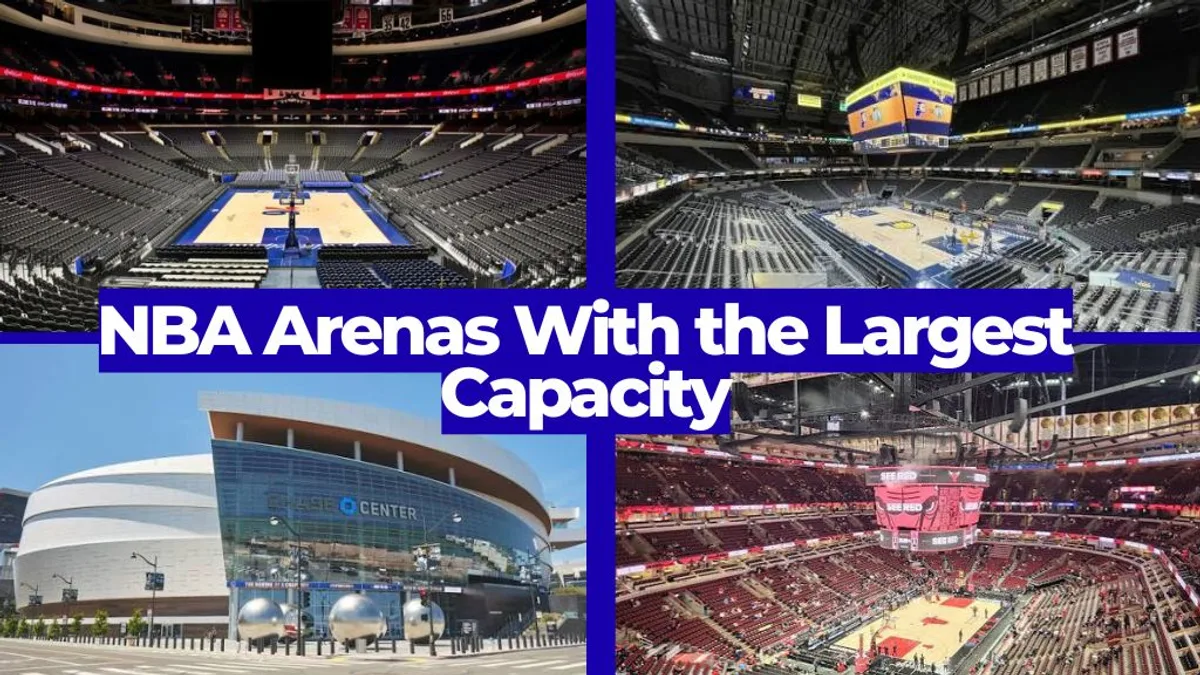
The United Center in Chicago is the largest NBA arena by seating capacity, holding about 20,917 fans for basketball as of 2026. It is followed by Philadelphia’s Wells Fargo Center at roughly 20,478 and Washington’s Capital One Arena at about 20,356. Only four NBA buildings currently seat more than 20,000 for a basketball game.
How NBA arena capacity is measured
NBA arena capacity figures reflect basketball-configuration seating, which differs from the concert or hockey setups in the same building. Most arenas are multi-purpose facilities that add or remove sections depending on the event, so a hockey or concert capacity for the same venue can run a few thousand higher. Basketball setups also fold in courtside and lower-bowl premium seating that shifts with renovations, which is why published figures are rounded and change over time. When rankings compare arenas, they use each building’s official basketball capacity so the numbers are measured the same way.
The largest NBA arenas by capacity
Four arenas anchor the top of the list as of the 2025-26 season, and the gap between them is small. Each of these buildings seats more than 20,000 fans for a basketball game, something no other NBA venue currently does.
United Center (Chicago Bulls) — about 20,917. Home to the Bulls since 1994, the United Center still carries the Jordan-era legacy and remains one of the loudest buildings in the league on a packed night. Its capacity has kept it at the top of the NBA list for years, and its sheer size makes it a demanding road environment.
Wells Fargo Center (Philadelphia 76ers) — about 20,478. The Sixers’ South Philadelphia home sits second in the league by basketball capacity. Philadelphia crowds have a reputation for intensity, and the building’s scale only amplifies the noise during playoff runs.
Capital One Arena (Washington Wizards) — about 20,356. Located in downtown Washington, D.C., Capital One Arena is the third-largest NBA venue and has anchored the Wizards’ home slate for decades. Ongoing renovations to its concourses and premium areas have kept it competitive with newer buildings.
Little Caesars Arena (Detroit Pistons) — about 20,332. Little Caesars Arena brought the Pistons back downtown in 2017 and paired modern amenities with a large seating bowl. Its flexible design lets sightlines and atmosphere shift depending on the event, and its capacity keeps it just inside the 20,000-plus club.
Madison Square Garden (New York Knicks) — about 19,800. MSG does not top the list by seat count, but no other basketball venue carries its cultural weight. The Knicks’ home in Midtown Manhattan has hosted championship runs and historic performances, which is why it is still called the world’s most famous arena regardless of what the capacity chart says.
NBA arena capacity leaderboard
| Rank | Arena | Team | Approx. basketball capacity | Opened |
|---|---|---|---|---|
| 1 | United Center | Chicago Bulls | ~20,917 | 1994 |
| 2 | Wells Fargo Center | Philadelphia 76ers | ~20,478 | 1996 |
| 3 | Capital One Arena | Washington Wizards | ~20,356 | 1997 |
| 4 | Little Caesars Arena | Detroit Pistons | ~20,332 | 2017 |
| 5 | Madison Square Garden | New York Knicks | ~19,800 | 1968 |
| 6 | Ball Arena | Denver Nuggets | ~19,520 | 1999 |
| 7 | Rocket Mortgage FieldHouse | Cleveland Cavaliers | ~19,432 | 1994 |
| 8 | Chase Center | Golden State Warriors | ~18,064 | 2019 |
| 9 | Intuit Dome | LA Clippers | ~18,000 | 2024 |
Figures reflect official basketball-configuration capacity and are rounded; verify current numbers with each arena as configurations change.
Why capacity does not equal home-court advantage
A bigger building can add to the wall of noise a visiting team faces, but seat count alone does not decide games. Some of the loudest and toughest road environments in the league are smaller or older venues where crowd energy, low ceilings, or altitude matter more than raw capacity. Denver’s Ball Arena, for example, benefits from mile-high altitude far more than from its mid-pack seat count. Modern arena design reflects this: newer buildings often trade a few thousand seats for steeper lower bowls, better sightlines, and premium sections that keep fans closer to the floor and louder where it counts.
Current and next-generation NBA arenas (2024-2026)
The most significant recent addition is the Clippers’ Intuit Dome in Inglewood, which opened in August 2024 and hosted the 2026 NBA All-Star Game. At roughly 18,000 basketball seats, it is deliberately smaller than the league’s largest venues, instead leaning into a 360-degree LED “Halo Board,” seat-back technology, and one of the steepest fan sections in the NBA. It is scheduled to host basketball at the 2028 Summer Olympics. Its design captures the direction of the league: several franchises exploring new buildings or major renovations are prioritizing premium seating and fan experience over maximum capacity, so the arenas at the top of the capacity list are increasingly older buildings rather than the newest ones.
Bottom line
As of 2026, the United Center remains the NBA’s largest arena at about 20,917 seats, trailed closely by the Wells Fargo Center, Capital One Arena, and Little Caesars Arena, the only other buildings that top 20,000. Iconic venues like Madison Square Garden rank lower by capacity but higher in reputation, and the newest arenas such as the Intuit Dome show that the league now measures a great building by its experience as much as its seat count.
Frequently asked questions
What is the largest NBA arena by seating capacity?+
The United Center in Chicago, home of the Chicago Bulls, is the largest NBA arena, seating about 20,917 fans for basketball as of 2026. It has held that top spot for years and is the only NBA building with an official basketball capacity above 20,900.
Which NBA arenas hold more than 20,000 fans?+
As of the 2025-26 season, four NBA arenas seat more than 20,000 for basketball: the United Center (Chicago), Wells Fargo Center (Philadelphia), Capital One Arena (Washington), and Little Caesars Arena (Detroit). Most other arenas fall in the 18,000-19,800 range.
How many seats does an average NBA arena have?+
Most NBA arenas seat between 18,000 and 20,000 fans for basketball, with the league average sitting near 18,500 to 19,000. Basketball configurations are usually slightly smaller than the same building's hockey or concert setups.
Which NBA arena is the newest?+
The Intuit Dome in Inglewood, California, home of the LA Clippers, is the newest NBA arena. It opened in August 2024 and seats roughly 18,000 for basketball, prioritizing sightlines and technology over raw capacity.
Is Madison Square Garden the biggest NBA arena?+
No. Madison Square Garden seats about 19,800 for basketball, which places it in the middle of the pack rather than at the top. Its reputation as the world's most famous arena comes from history and location, not seat count.
Why do NBA arena capacity figures change?+
Capacities shift because arenas are multi-purpose buildings that reconfigure seating for basketball, hockey, and concerts, and because renovations add or remove premium seating. Standing-room and obstructed-view sections can also be counted differently from year to year.
Does a bigger arena create a stronger home-court advantage?+
A larger, louder building can add to the noise and intensity a visiting team faces, but home-court advantage depends more on crowd energy, altitude, and travel than on raw seat count. Smaller, older arenas are often among the loudest in the league.
Which NBA teams are planning new arenas?+
Several franchises have explored new buildings or major renovations in recent years, and modern designs tend to favor premium seating and fan experience over maximum capacity. The Clippers' Intuit Dome, opened in 2024, is the most recent example of this trend.
Sources
Play & tools
Free browser games and tools — no account, no download.
- Play 82-0 — Draft five, one per position, and see if your lineup can go a flawless NBA season.
- Play Era Ball — Draft an all-time NBA roster from a single era, then simulate a season and chase a perfect run.
- Play 32-0 — Draft five college basketball legends, one per position, and chase a perfect 32-0 national title.
- Explore all our games →
- Get the printable bracket — Download and print a blank tournament bracket to fill out by hand.
- Open the TS% calculator — Calculate TS% from points, field goal attempts and free throw attempts — scoring efficiency in one number.
- Explore all our free sports tools →
Related basketball guides
View all →
Highest-Paid NBA Coaches: Reported Salaries
Steve Kerr and Gregg Popovich top NBA coaching pay, both reported near $16-17M a year. Full table, with every figure flagged as an estimate.
Longest Winning Streak in NBA Playoffs: Ranked
The 2017 Warriors won 15 straight playoff games, the NBA record. The 2026 Knicks came closest with 13. All 10 longest single-postseason streaks, ranked.
Most Points in an NBA Game: Wilt's 100
Wilt Chamberlain scored 100 points in a single NBA game on March 2, 1962, the all-time record. Kobe's 81 leads the modern era. Full table.
Most Points in an NBA Season: Wilt's 4,029
Wilt Chamberlain holds the NBA single-season scoring record with 4,029 points in 1961-62, at 50.4 per game. Full table of the highest-scoring seasons.
The 50-40-90 Club in the NBA (Every Season)
Steve Nash leads the NBA 50-40-90 club with four seasons. Nine players have shot 50% FG, 40% 3PT and 90% FT in a season. The full list, explained.
Back-to-Back NBA Champions (Every Repeat Winner)
The Boston Celtics won eight straight NBA titles from 1959-1966. Full list of back-to-back and three-peat NBA champions, and why repeating is rare.