
Era Ball Eras Compared: Best NBA Decade to Draft
On this page9
- 011950s and 1960s: no three-point line, size dominates
- 021970s: the game starts to open up
- 031980s: the three-point line arrives, but stays situational
- 041990s: peak physicality
- 052000s: isolation and rim protection
- 062010s: the spacing revolution
- 072020s: maximum pace, maximum spacing
- 08What this actually means for your draft
- 09Try the same era-fit challenge, with the reasoning shown
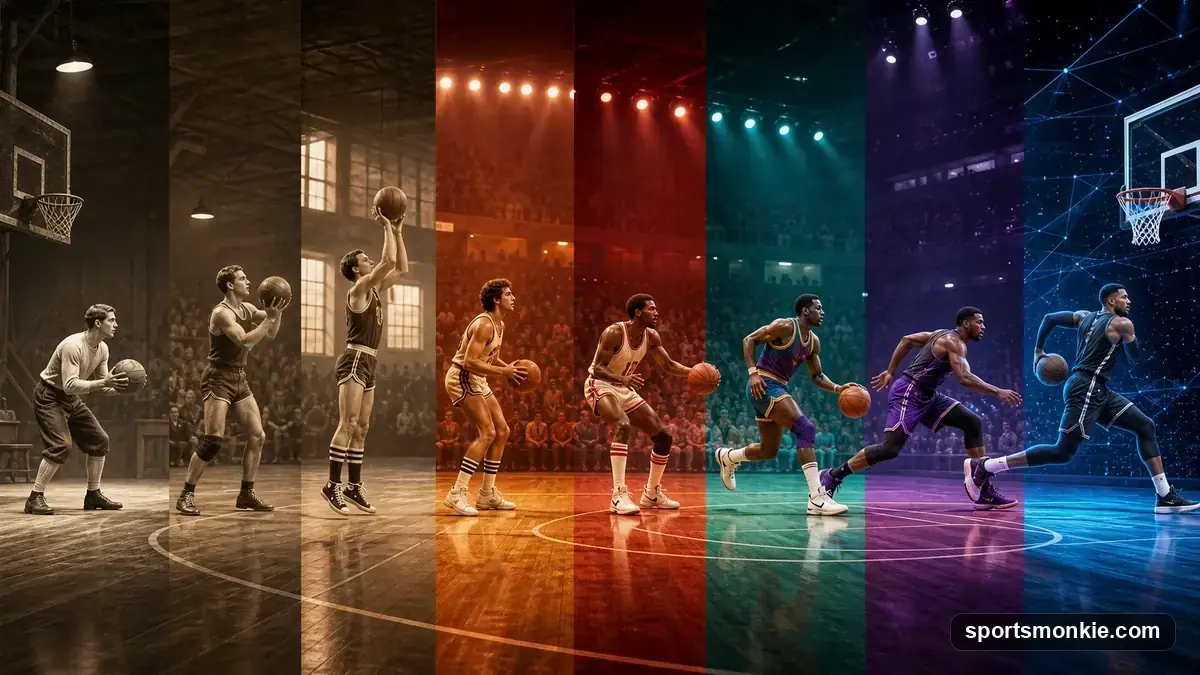
Era Ball’s era selection isn’t just flavor text on top of the same underlying game — the actual rules of basketball changed enough across NBA history that “best roster” genuinely means something different depending which decade you pick. Here’s what changed, decade by decade.
1950s and 1960s: no three-point line, size dominates
The three-point line didn’t exist in the NBA until the 1979-80 season, so both of these decades are built entirely around two-point shot selection and rebounding. The 1960s in particular is remembered as an extremely fast, high-possession era — teams ran constantly, which inflated raw counting stats league-wide. Dominant, high-usage centers are the defining archetype of both decades.
1970s: the game starts to open up
Still pre-three-point-line for most of the decade, but individual shot creation and transition offense become more prominent than the pure size-and-rebounding focus of the prior two decades. This is a transitional era stylistically — more balanced than the 1950s/60s, still fundamentally a half-court, post-oriented game by modern standards.
1980s: the three-point line arrives, but stays situational
The three-pointer exists now but functions as a specialty shot rather than a base offensive weapon — teams built their offense inside-out, not around volume shooting from range. Fast breaks, flashy playmaking, and a genuine inside-outside balance define the decade.
1990s: peak physicality
Hand-checking — a defender using their hands to impede a ball-handler on the perimeter — was legal and heavily used through this decade, and it shows in the league-wide numbers: lower scoring, more contact, and a premium on individual defense and toughness that’s hard to replicate in later, more restricted rule sets. Grind-it-out halfcourt basketball is the dominant style.
2000s: isolation and rim protection
Scoring stayed relatively low into the early 2000s, with a heavy reliance on individual isolation scoring, strong rim protection, and the midrange jumper as a primary weapon rather than a fallback. The three-point revolution hadn’t arrived yet.
2010s: the spacing revolution
This is the decade the three-pointer stopped being a specialty shot and became a base offensive weapon. Position-versatile rosters and efficient shot selection (three-pointers and shots at the rim, at the expense of the midrange) started to define winning basketball.
2020s: maximum pace, maximum spacing
The natural extension of the 2010s shift — higher three-point volume than any prior era, switchable positionless defense as the counter to modern spacing, and efficient shot selection as close to a league-wide mandate as basketball has had.
What this actually means for your draft
A roster of elite three-point shooters is a weapon in the 2010s or 2020s and closer to dead weight in the 1950s or 1960s, where that shot barely exists. A bruising, physical rim-runner fits the 1990s far better than the spaced-out, switch-everything 2020s. Picking your era first, then drafting to fit it — rather than drafting star power and hoping it translates — is the difference most people miss.
Try the same era-fit challenge, with the reasoning shown
Era Ball applies this same principle directly to its ratings: every player card carries an “era fit” score against whichever decade you’re simulating, and the chemistry panel calls out an “Era Specialists” bonus or a “Poor Era Fit” penalty by name, so you can see exactly how much your roster’s real-world style matches the decade you picked. Free, no account required.
Frequently asked questions
Which decades can you play in Era Ball?+
Eight: the 1950s, 1960s, 1970s, 1980s, 1990s, 2000s, 2010s, and 2020s.
Does the three-point line affect older-era simulations?+
It has to — the three-point line wasn't introduced to the NBA until the 1979-80 season, so any 1950s, 1960s, or most-of-the-1970s simulation is working with rosters that essentially don't shoot threes at all, which changes spacing and shot selection completely compared to modern eras.
Does hand-checking affect Era Ball?+
Realistically, yes, in the sense that the rule changed dramatically across the eras Era Ball simulates. Hand-checking on the perimeter was legal and common through the 1990s and was significantly restricted starting in the 2004-05 season specifically to open up scoring — a 1990s-style physical defender and a 2020s-style switchable defender aren't playing by the same rulebook.
Which era had the strongest defense?+
The 1990s is the era most commonly pointed to for defensive physicality, thanks to legal hand-checking and generally lower league-wide scoring, though earlier eras like the 1970s were also low-scoring for different reasons — less spacing and a slower, more half-court-oriented game overall.
Which era had the best offense?+
By pure scoring efficiency and spacing, the 2010s and 2020s stand apart — three-point volume and analytics-driven shot selection pushed league-wide offensive efficiency higher than any prior era on record.
Which era had the strongest players overall?+
There's no settled answer — it's the exact argument this genre of game exists to test rather than resolve. What's clear is that eras aren't directly comparable on raw stats alone: a dominant 1960s center racked up numbers in a much faster, less-defended league than a 2020s big man faces, so "strongest" depends heavily on how you adjust for context.
Would modern NBA players dominate older eras, or would old legends dominate today?+
Both directions of that argument have a real basis. Modern players trained under today's spacing, shooting, and athletic-development standards would likely exploit the lack of a three-point line in 1960s defenses. Older legends dropped into today's rules would lose some advantages (illegal defenses, no shot clock pressure in some early years) but many, like Wilt Chamberlain's rebounding profile, remain statistically dominant by any era's standard. This exact debate is the core appeal of the genre — nobody settles it for free.
How does Era Ball handle a player whose real career spanned multiple decades?+
By era-specific cards rather than one blended career entry — a player like Michael Jordan or LeBron James appears as separate, distinct cards for each decade they played at a high level, not a single averaged-out version. See [how to play](/how-to-play-era-ball/) for how that shapes the draft.
How are players from before the three-point line evaluated?+
On the same era-adjusted stat model as everyone else, just without a meaningful three-point volume to weigh — their real value came almost entirely from two-point scoring, rebounding, and defense, which is exactly what the simulation rates them on for a pre-1979-80 build.
Sources
Play & tools
Free browser games and tools — no account, no download.
- Play 82-0 — Draft five, one per position, and see if your lineup can go a flawless NBA season.
- Play Era Ball — Draft an all-time NBA roster from a single era, then simulate a season and chase a perfect run.
- Play 32-0 — Draft five college basketball legends, one per position, and chase a perfect 32-0 national title.
- Explore all our games →
- Get the printable bracket — Download and print a blank tournament bracket to fill out by hand.
- Open the TS% calculator — Calculate TS% from points, field goal attempts and free throw attempts — scoring efficiency in one number.
- Explore all our free sports tools →
Related basketball guides
View all →
82-0 Alternatives: Era Ball, Daily82, Ball IQ and More Compared
If you've played 82-0, here's how Era Ball, Daily82, and Ball IQ's Ultimate Team actually differ — and what to try next.
Best Era Ball Players by Position: Who to Target in the Draft
Which real NBA statistical profiles make the strongest Era Ball picks at each position — and why some star names are better fits than others.
What Is Era Ball? Basketball Draft Game Explained
Era Ball is a free basketball draft game built around NBA eras. Learn its nine-player format, position penalties, modes and where to play.
How to Play Era Ball: Draft, Coach & Sim a Season
Learn Era Ball fast: pick an era, draft your nine-player roster, choose a coach, then simulate the season and playoffs. A quick, free how-to guide.

Era Ball Alternatives: 82-0, 98-0, Daily82 & More
The best Era Ball alternatives: how 82-0, 98-0, Daily82, iKnoBall and our own draft-and-sim games compare, across basketball and other sports.

Era Ball Features: Challenges, Leaderboards & Cards
Era Ball's Weekly Challenge, Leaderboard, Lifetime Stats, Achievements and Card Collection, explained — plus how to join the community.