
Best NFL Nose Tackles of All Time
On this page13
- 01The best NFL nose tackles at a glance
- 02Curley Culp
- 03Cortez Kennedy
- 04Vince Wilfork
- 05Ted Washington
- 06Haloti Ngata
- 07Dexter Lawrence
- 08Vita Vea
- 09How we ranked the nose tackles
- 10What the nose tackle actually does
- 11At a glance: the all-time nose tackles
- 12Era caveats when comparing them
- 13Why the position gets overlooked
We ranked on point-of-attack dominance first: how consistently a player held the A-gaps, drew double teams, and let linebackers run free. Accolades (Hall of Fame, DPOY, Pro Bowls) and how purely a player fit the true zero-technique nose role broke ties. Modern pass-rush production was a bonus, not the baseline.
The best NFL nose tackles at a glance
| Rank | Player | Strongest argument |
|---|---|---|
| 1 | Curley Culp | Pioneered the 3-4 nose; 1975 DPOY |
| 2 | Cortez Kennedy | 1992 DPOY with 14 interior sacks |
| 3 | Vince Wilfork | Five Pro Bowls and two Super Bowls |
| 4 | Ted Washington | Elite run defense across 17 seasons |
| 5 | Haloti Ngata | Run anchor with pass-rush value |
| 6 | Dexter Lawrence | Modern double-team and sack production |
| 7 | Vita Vea | Powerful run anchor with pass rush |
- The prototype
Curley Culp
Culp is the closest thing the position has to a founding father. Kansas City slid him over the center in a three-man front to beat Minnesota in Super Bowl IV, and after a 1974 trade to Houston he became the full-time nose that made Bum Phillips' 3-4 defense go. He won 1975 Defensive Player of the Year in his first full season as an Oilers nose tackle.
He ranks above Cortez Kennedy on this specific list because no one defined the role more literally: a six-time Pro Bowler, Pro Football Hall of Fame inductee (2013), and the man coaches point to when they explain why the two-gap nose exists at all.
Teams: Chiefs, Oilers, Lions · Peak: 1975 DPOY · Defining feat: pioneered the 3-4 nose, HOF 2013
- Best peak
Cortez Kennedy
Kennedy owns the strangest dominant season the interior has produced. In 1992 he won Defensive Player of the Year on a Seattle team that finished 2-14, posting 14 sacks, 92 tackles, and four fumble recoveries from inside. Offenses had no reason to scheme around a losing team's tackle and still could not block him one-on-one.
He edges Wilfork on sheer disruptive peak rather than hardware, though he has both: Kennedy entered the Pro Football Hall of Fame in 2012. He played more of a shaded 4-3 tackle than a true zero-technique, which is the only reason he sits behind Culp.
Team: Seahawks · Peak: 1992 DPOY on a 2-14 team · Defining feat: 14 sacks from the interior, HOF 2012
- Dynasty anchor
Vince Wilfork
Wilfork spent a decade doing the job nobody notices: swallowing a center and guard so New England's linebackers stayed clean. He never needed the box score, which is why his value shows up in championships instead. He won two Super Bowls with the Patriots (following the 2004 and 2014 seasons) and made five Pro Bowls.
He ranks below Kennedy because his individual seasons rarely spiked the way Kennedy's 1992 did, but few nose tackles sustained his level for as long against elite competition. Wilfork was named a modern-era nominee for the 2026 Hall of Fame class, keeping his Canton case alive.
Teams: Patriots, Texans · Peak: 2 Super Bowls, 5 Pro Bowls · Defining feat: 350-plus-pound double-team magnet
- Immovable
Ted Washington
Washington built a 17-year career on being physically impossible to single-block. At 6-foot-5 and roughly 375 pounds, he is one of the heaviest NFL players ever to start at a skill-defining position, and he used every pound to wall off the run for seven different franchises.
He sits behind Wilfork on accolades (four Pro Bowls to Wilfork's five, plus Wilfork's two rings) but ahead of the modern names on pure longevity: Washington was still eating blocks and controlling gaps into his late 30s, winning a Super Bowl with New England after the 2003 season.
Teams: Seven, incl. Bills, Bears, Patriots · Peak: 4 Pro Bowls, 17 seasons · Defining feat: 375-lb run-defense wall
- Two-way threat
Haloti Ngata
Ngata was the piece Baltimore could not replace even while Ray Lewis and Ed Reed took the headlines. He held the point against the run and still collapsed pockets on passing downs, a combination most space-eaters never offer. A five-time Pro Bowler, he anchored the front of the Ravens' Super Bowl XLVII team after the 2012 season.
He ranks below Washington because his prime, while more versatile, was shorter, and he spent his later years in Detroit and Philadelphia as a rotational piece rather than a fixture. At his best, though, he was harder to game-plan against than anyone below him.
Teams: Ravens, Lions, Eagles · Peak: 5 Pro Bowls, 2012 title front · Defining feat: run stuffer who also rushed the passer
- Best active
Dexter Lawrence
Lawrence is the rare nose tackle who wrecks games as both a two-gapper and a rusher. In 2024 he posted a career-high nine sacks in just 12 games before an elbow injury, while facing a 74.5% double-team rate, higher than any other interior lineman, per Giants and ESPN reporting. He earned his third straight Pro Bowl nod.
He lands here rather than higher only because his all-time résumé is still being written. In a 2025 ESPN survey of coaches, scouts, and executives, he was voted the league's top defensive tackle, and rival staffs increasingly call him the best nose tackle in football.
Team: Giants · Peak: 9 sacks in 2024 (12 games) · Defining feat: 74.5% double-team rate, 3x Pro Bowl
- Current standout
Vita Vea
Vea gives Tampa Bay a 340-plus-pound nose who anchors the run and still generates interior pressure, leading NFL nose tackles in sacks by StatsPass classification during his best seasons. He was voted to the Pro Bowl for the 2025 Games, his second selection after 2021.
He ranks just behind Lawrence because his sack peak (a career-high in 2024) trails Lawrence's, and his double-team burden, while heavy, is not the historic outlier Lawrence carries. Together they prove the modern nose can still tilt a game in a pass-first era. For contrast on the other end of the anonymity spectrum, see the best NFL long snappers.
Team: Buccaneers · Peak: 2 Pro Bowls, career-high sacks in 2024 · Defining feat: 340-plus-lb run anchor with pass-rush juice
Reader interaction
Build your ranking
Drag the names into the order you think is right — or use the arrows — then submit to see how your list compares with everyone else's.
- Curley Culp
- Cortez Kennedy
- Vince Wilfork
- Ted Washington
- Haloti Ngata
- Dexter Lawrence
- Vita Vea
Audience ranking
How everyone ranked them
Built from reader rankings using position-based points.
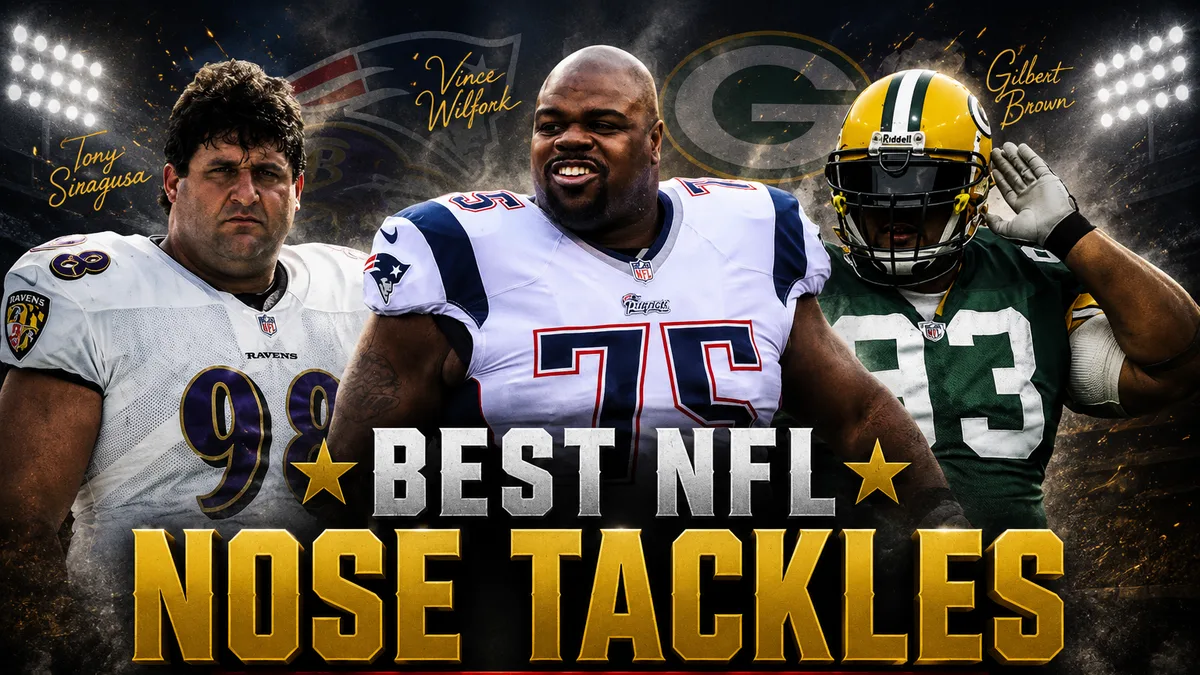
Ask a defensive coordinator which player is hardest to replace, and plenty of them point to the nose tackle before the sack leader or the shutdown corner. The best NFL nose tackles are the 340-pound anchors who get doubled by a center and a guard on every snap so a linebacker four yards behind them can run free and make the tackle everyone remembers. The ranking above puts them in order; the sections below explain how we weighed them and why the position is judged on tape more than the box score.
How we ranked the nose tackles
Our order is built on point-of-attack dominance first. The core question for each player: how reliably did he hold both A-gaps, force offenses to commit two blockers, and keep his linebackers clean? That is the actual job description of a two-gap nose, and it is what separates a great one from a merely large one.
From there we weighed three tiebreakers:
- Purity of role. A true zero-technique lined up over the center scores higher than a shaded tackle who happened to play some nose. That is why Curley Culp edges Cortez Kennedy despite both being Hall of Famers.
- Accolades and longevity. Defensive Player of the Year, Hall of Fame status, Pro Bowls, and years spent as a fixture rather than a rotational piece.
- Modern disruption as a bonus. Interior pass rush is a plus for a nose, not the baseline. It lifts players like Dexter Lawrence and Vita Vea, but it never outranks run-game control.
Aaron Donald, for the record, is not on the list. He is the best interior lineman of his era, but he played three-technique, not nose. The football defensive positions guide explains why that alignment difference matters.
What the nose tackle actually does
In a 3-4 defense, the nose lines up directly over the center, the most physically punishing spot on the line. The job is not to rack up statistics. It is to eat double teams, collapse the pocket into the quarterback’s lap, plug inside running lanes before they open, and hold the point of attack without ever being driven back or sealed. When a nose does this well, the whole front functions; when he cannot, every linebacker’s job gets harder.
At a glance: the all-time nose tackles
| Rank | Player | Era | Team(s) | Calling card |
|---|---|---|---|---|
| 1 | Curley Culp | 1968–1981 | Chiefs, Oilers | 1975 DPOY, HOF, pioneered the 3-4 nose |
| 2 | Cortez Kennedy | 1990–2000 | Seahawks | 1992 DPOY on a 2-14 team, HOF |
| 3 | Vince Wilfork | 2004–2016 | Patriots, Texans | 2 Super Bowls, 5 Pro Bowls |
| 4 | Ted Washington | 1991–2007 | Seven teams | 375 lbs, 17 seasons, immovable |
| 5 | Haloti Ngata | 2006–2018 | Ravens, Lions, Eagles | 5 Pro Bowls, run-and-pass anchor |
| 6 | Dexter Lawrence | 2019–present | Giants | 9 sacks in 2024, top DT in exec polling |
| 7 | Vita Vea | 2018–present | Buccaneers | 2 Pro Bowls, leads noses in sacks |
Era caveats when comparing them
Ranking noses across 50 years means comparing different jobs. Culp and the early 3-4 pioneers played when sacks were unofficial and offenses ran far more; their value was almost entirely in the run game. Wilfork and Washington worked in the two-gap, keep-it-simple era of the 2000s. Lawrence and Vea play in a pass-first league where a nose who can also rush the passer is worth far more snaps than a pure space-eater would be today. Weight the accolades accordingly, and read older sack totals as a rough guide, not a clean comparison to modern numbers.
Why the position gets overlooked
Nose tackles suffer the same statistical invisibility as long snappers and offensive linemen. They rarely lead the league in sacks, and their tackles often come after two-yard gains that were supposed to go for four. Their value lives in what never happens: the cutback lane that closes before the back finds it, the run that dies at the line because nobody could move the man in the middle. That is why coaches, snap counts, and film study, more than the stat sheet, tell the real story of who the best nose tackles are.
To turn that position knowledge into a draft choice, try Flawless Six and decide how much of a six-pick roster to invest in defense. NFL Connections is the better fit when you want a daily puzzle built around teams, players, roles, and shared football links.
Frequently asked questions
Who is the best nose tackle in NFL history?+
There is no single settled answer, but Curley Culp has the strongest claim as a pure nose tackle. He pioneered the two-gap zero-technique role in the 3-4 defense, won 1975 Defensive Player of the Year, and reached the Hall of Fame in 2013. Cortez Kennedy is the other name at the top thanks to his 1992 DPOY season, though he played more of a shaded 4-3 tackle than a true nose.
What is the difference between a nose tackle and a defensive tackle?+
A nose tackle lines up directly over the center in a 3-4 defense and is mainly responsible for absorbing blockers and holding the point of attack. Defensive tackle is a broader term for interior linemen, including 4-3 three-techniques who penetrate and rush the passer. Nose tackles are usually heavier and prioritize gap control over sacks. Our guide to football defensive positions breaks the alignments down in more detail.
How big are NFL nose tackles?+
Elite nose tackles typically weigh between 320 and 350 pounds, and some go well beyond that. Ted Washington played around 375 pounds and Vince Wilfork played north of 350. Size alone is not enough, though. Leverage, hand technique, pad level, and the football IQ to read blocking schemes matter as much as raw mass, which is why not every huge lineman can play the nose.
Is Aaron Donald a nose tackle?+
No. Aaron Donald played mostly as a three-technique defensive tackle for the Rams, not a nose tackle over the center. He is the greatest interior disruptor of the modern era, with 111 career sacks and three Defensive Player of the Year awards, but positionally he is a penetrating tackle, not a two-gap nose, which is why he is not ranked on this list of true nose tackles.
Who is the best nose tackle in the NFL right now?+
As of 2026, Dexter Lawrence of the New York Giants is widely regarded as the best nose tackle in the league. He recorded a career-high nine sacks in 2024, unusual for a two-gap zero-technique, earned his third straight Pro Bowl, and topped a 2025 ESPN survey of coaches and executives as the best defensive tackle. Vita Vea of Tampa Bay is the other top current name at the position.
Is Vince Wilfork in the Hall of Fame?+
Not yet, as of 2026. Wilfork won two Super Bowls with New England and made five Pro Bowls, and he was named a modern-era nominee for the Pro Football Hall of Fame's 2026 class. He was inducted into the Patriots Hall of Fame in 2022, a team honor separate from Canton. His case for the Pro Football Hall of Fame continues to advance through the selection process.
Sources
Play & tools
Free browser games and tools — no account, no download.
- Play 17-0 — Draft nine and chase a flawless NFL regular season — the perfect 17-0 run, no playoffs.
- Play 20-0 — Draft nine and chase a perfect NFL season — regular season and playoffs, undefeated.
- Play 16-0 — Draft nine and chase a perfect 16-0 — the classic 16-game NFL regular season, no playoffs.
- Play Flawless Six — Draft five players and a head coach, then chase a perfect NFL season with the right chemistry.
- Play Guess the NFL Player — A new mystery NFL player every day. Eight guesses, with a clue on each — plus free unlimited mode.
- Play NFL Wordle — A Wordle for football — guess the daily NFL player in eight tries, with green-amber-grey feedback on every clue.
- Play NFL Connections — Sort sixteen football tiles into four hidden groups of four. A new daily puzzle, four mistakes allowed, plus unlimited mode.
- Explore all our games →
- Open the schedule simulator — Pick every 2026 NFL game and watch the standings and playoff seeds update live.
- Open the squares generator — Generate a randomized, printable Super Bowl squares grid for your party — free, no sign-up.
- Open the trade calculator — Weigh any fantasy football trade instantly — clear winner and value gap.
- Run the NFL predictor — Simulate the NFL bracket and see who your picks send to the Super Bowl.
- Open the passer rating calculator — Calculate the official NFL passer rating (0–158.3) from any passing line, with the formula shown.
- Explore all our free sports tools →
Related nfl guides
View all →
Best NFL Fullbacks of All Time, Ranked
The best NFL fullbacks ranked, from Lorenzo Neal and Larry Csonka to Kyle Juszczyk, judged on lead blocking, short-yardage power, receiving and versatility.
Best NFL Long Snappers of All Time: The Invisible Specialists
The best NFL long snappers go unnoticed for a decade, then one bad snap ends a season. Here are the greatest ever ranked, with the records that separate them.
What Is a Blitz in American Football? Pressure Package Explained
A blitz sends more pass rushers than the standard rush, trying to pressure the quarterback before the offense can exploit the extra defender.
Cover 2 Defense in Football: Rules, Alignment, and Weaknesses Explained
Cover 2 defense explained: two deep safeties split the field, five underneath defenders, strengths vs. deep passes, weaknesses in the middle, and the Tampa 2 twist.
Cover 4 Defense (Quarters Coverage) in Football: Rules and Weaknesses
Cover 4 defense explained: four deep defenders split the field into quarters, pattern-match rules, run strengths, and how it differs from Cover 2/Cover 3.
Cover 3 Defense in Football: How It Works, Strengths & Weaknesses
Cover 3 defense explained: three deep defenders split the field into thirds while four underneath defenders play zone. Strengths, weaknesses, and how to beat it.