
Cricket vs Football: Key Differences and Similarities
On this page5
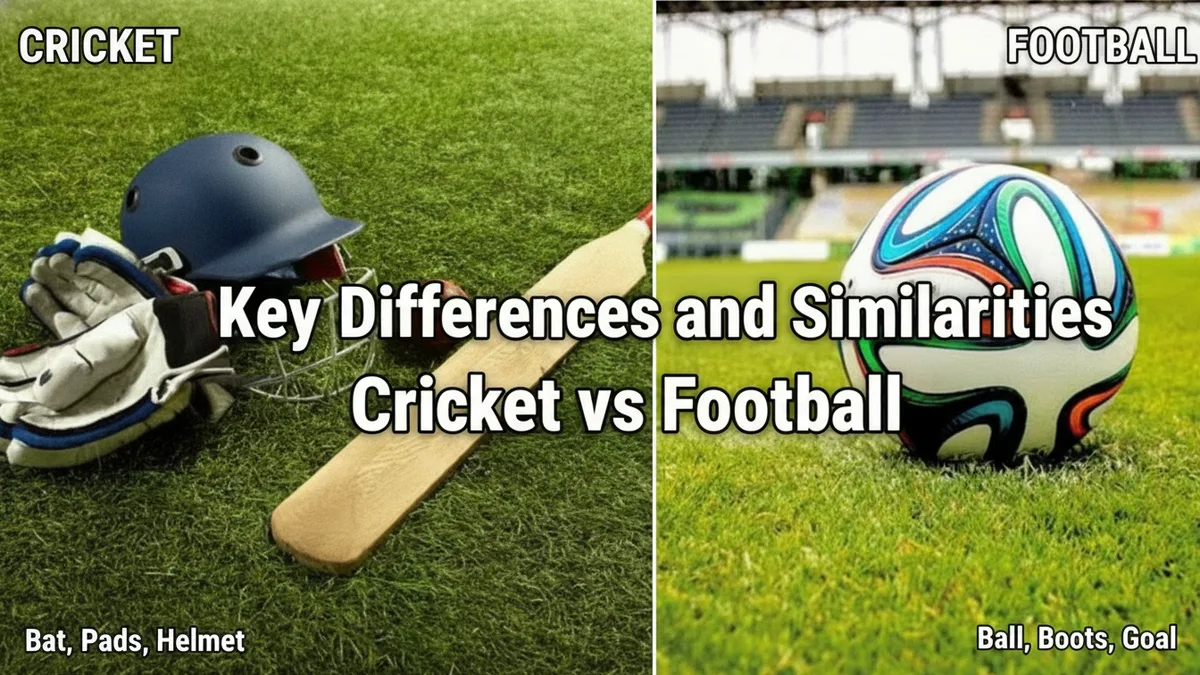
Put a football fan in front of a Test match and the first thing they’ll ask is why nobody’s won after six hours of play. Put a cricket fan in front of a football match and they’ll wonder why it’s over so fast. Both sports trace back to England, both field 11 players a side, and that’s roughly where the resemblance ends. Between them they cover most of the planet’s sporting attention, just not the same parts of it.
Key differences at a glance
| Feature | Cricket | Football (Soccer) |
|---|---|---|
| Players per side | 11 | 11 |
| Match duration | 3 hours (T20) to 5 days (Test) | 90 minutes (standard) |
| Scoring unit | Runs | Goals |
| Ball | Hard leather ball (~156–163 g) | Inflated leather ball (~410–450 g) |
| Playing area | Oval/circular field, ~65–90 yards to boundary | Rectangular pitch, 100–110 m × 64–75 m |
| Equipment | Bat, stumps, pads, helmet | Boots, shin pads |
| Draws | Common (especially in Tests) | Less common |
| Global governing body | ICC | FIFA |
How the games actually work
Cricket splits into two clear jobs: one team bats, the other fields, and everyone knows which is which at any given moment. Batters run between two sets of stumps to score, bowlers try to get them out by hitting the stumps or forcing a catch, and whoever has more runs once both innings are done wins.
Football never really stops. Both teams attack and defend in the same 90 minutes, moving the ball with feet and body (hands only for the goalkeeper), and whoever scores more goals wins. Knockout matches that finish level go to extra time and then penalties.
What the two sports actually share
Football’s rules were codified in 1863; cricket’s have been maintained by the MCC since the 18th century, so both have a genuinely English paper trail. Both use 11 players a side in their standard format. Both run serious international structures, World Cups, bilateral series, domestic leagues that matter to millions. And the same handful of countries, England, Australia, India, Pakistan, follow both sports heavily rather than picking one. Field placement in cricket and tactical shape in football serve the same purpose too: neither game rewards raw athleticism without a plan behind it.
Format and audience
| Aspect | Cricket | Football |
|---|---|---|
| Shortest format | T20 (~3 hours) | 90 minutes |
| Longest format | Test (5 days) | 90 min + ET |
| Global audience reach | Huge in South Asia, Aus, UK, Caribbean | Truly global |
| Domestic leagues | IPL, Big Bash, The Hundred | Premier League, La Liga, Bundesliga |
Why the comparison keeps coming up
Both sports spread the same way, as British exports that took root in former colonies and never left. India and Pakistan are as cricket-obsessed as any country gets, yet both also have huge football followings that rarely make international headlines outside the subcontinent. England, Australia, South Africa, and the West Indies split their attention between the two in varying degrees, too.
Money is where the comparison gets sharper. Football’s global revenue is well beyond cricket’s on every measure that matters. But cricket’s Indian market, built almost entirely around the IPL and the BCCI, has grown into one of the most valuable properties in sport, full stop, not just in cricket.
Frequently asked questions
What is the main difference between cricket and football?+
The most fundamental difference is how scoring works and the role of the ball. In cricket, batters score runs by hitting the ball and running between wickets; in football, players score by putting the ball into the opposing net. Cricket uses a hard ball, a bat, and wickets; football uses a large inflated ball with only feet and headers.
How many players are in a cricket team vs a football team?+
A cricket team has 11 players on each side, the same as a football team. However, in cricket all 11 bat (two at a time) and all 11 can bowl, whereas in football positions are more strictly divided.
Which sport has more global fans — cricket or football?+
Football (soccer) has the largest global fanbase of any sport, with an estimated 3–4 billion followers worldwide. Cricket is second or third largest globally, with particularly huge followings in South Asia, the UK, Australia, and the Caribbean.
How long do cricket and football matches last?+
A football match lasts 90 minutes plus stoppage time, roughly two hours in total. Cricket varies hugely by format: a T20 takes about three hours, an ODI seven to eight, and a Test match up to five days. This makes cricket's timescale far more variable than football's.
Do cricket and football share any similarities?+
Both are team sports with 11 players a side, deep roots in British sporting culture, and global followings driven by major leagues and international tournaments. Each also relies on skill, strategy, and athleticism, and both generate huge television audiences and commercial revenue worldwide.
Which is harder to learn, cricket or football?+
Football's basic rules are simpler and quicker to grasp, which partly explains its global spread. Cricket has more complex laws, terminology, and formats, so it can take longer for newcomers to understand fully, though its core idea — hit the ball and score runs — is straightforward.
Why is cricket popular in some countries and football in others?+
Much of it stems from history, particularly the British Empire, which spread cricket to South Asia, Australia, and the Caribbean, and football almost everywhere else. Local culture, climate, infrastructure, and national success in each sport then reinforced these preferences over generations.
Sources
Play & tools
Free browser games and tools — no account, no download.
- Play today's Sports Connections — Today's Sports Connections — daily hints, answers, and play the grid.
- Play Guess the NFL Player — A new mystery NFL player every day. Eight guesses, with a clue on each — plus free unlimited mode.
- Explore all our games →
Related cricket guides
View all →
Rugby vs American Football: Key Differences
Rugby vs American football: rugby has 15 players, no forward pass and light padding; American football has 11, forward passing, downs and full pads.

Is Lacrosse Harder Than Football? A Fair Comparison
Is lacrosse harder than football? Lacrosse demands more continuous endurance and stickwork; football hits harder in bursts. Here's the honest comparison.

Lacrosse vs Field Hockey: Key Differences Explained
Lacrosse vs field hockey: one throws a ball through the air with a netted stick, the other pushes it along the ground. Compare rules, gear, and contact.
What Is a Dead Ball in Cricket? Rule and Common Situations
A dead ball is a delivery from which no runs score and no batter is out. Learn when the ball goes dead, who decides, and why it matters in a tight finish.
DLS Method in Cricket Explained: How Rain Targets Are Set
The Duckworth-Lewis-Stern (DLS) method resets targets in rain-hit limited-overs cricket using overs and wickets left. Here's the logic, with examples.
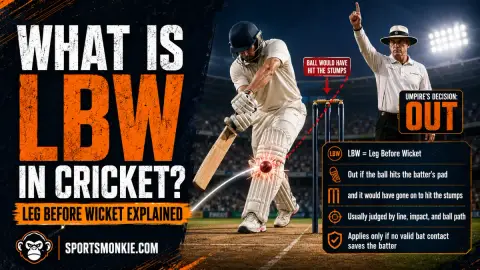
What Is LBW in Cricket? Leg Before Wicket Explained
LBW means the ball would have hit the stumps but struck the pad first. Here are the exact conditions umpires check and how DRS decides close calls.