
The Most Dangerous Sports in the World Ranked
On this page6
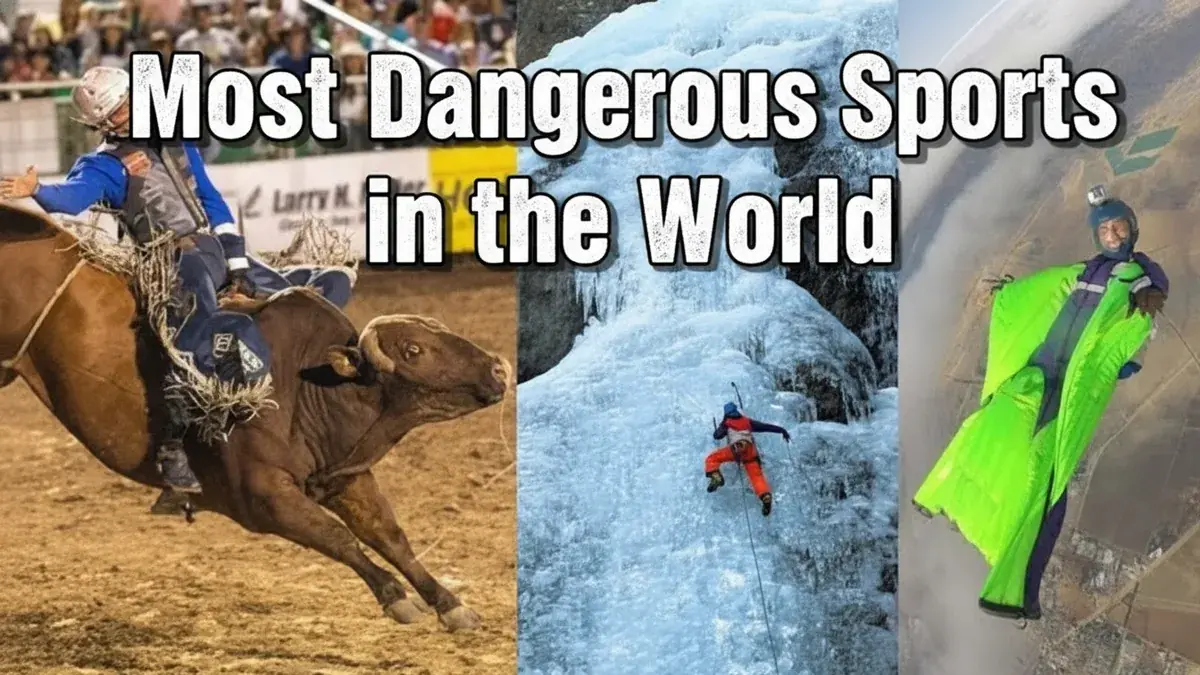
BASE jumping is the most dangerous sport in the world by fatality risk, killing roughly one participant per 500 to 2,300 jumps depending on the dataset. Free solo climbing and big-wave surfing sit close behind among individual pursuits, while American football, rugby, and boxing carry the heaviest long-term injury burden of any mainstream sport. What unites the top of this list is a lack of margin for error.
What makes a sport dangerous
Two things decide where a sport lands on a list like this: how often things go wrong, and how bad it is when they do. BASE jumping scores high on both counts, which is why it tops nearly every credible ranking. Boxing scores lower on how often catastrophic events happen but very high on cumulative severity, because head trauma stacks over a career rather than in a single moment.
Skill level and safety gear shift the numbers too. A well-equipped, experienced athlete faces a very different risk profile than a novice, and a sport’s governing body can move the needle with better barriers, protocols, and equipment. This ranking weighs fatality potential alongside serious-injury rates rather than relying on any single measure, and it distinguishes between sports where a mistake means a bruise and sports where a mistake means a coffin.
The most dangerous sports ranked
BASE jumping leads because the physics leave almost no room to recover. Jumpers leap from fixed structures such as buildings, antennas, spans, and cliffs at low altitude, so there is barely any time to fix a mistake mid-air. The 2025 BASE Fatality List recorded 29 deaths, among the higher annual totals of the past decade, and wingsuit flying accounts for a disproportionate share of them.
Free solo climbing carries its own brutal math. With no rope and no protection, a single slip is fatal almost every time. Alex Honnold’s 2017 free solo of El Capitan, nearly 3,000 feet of granite climbed without a rope, is the reference point people reach for precisely because the sport almost never allows for a single error.
Big-wave surfing at breaks like Nazaré and Jaws means waves that can top 20 metres. A bad wipeout can hold a surfer underwater through several wave cycles in a row, which is how shallow-water blackout and reef impacts happen even to surfers who have ridden waves that size before. Bull riding, high-speed motorsport, and equestrian eventing round out the top tier of individual and animal-involved sports, each combining speed or impact with limited protection.
Dangerous team and combat sports
American football’s reckoning with chronic traumatic encephalopathy, the degenerative brain disease tied to repeated head impacts, has forced the NFL and NCAA to rebuild their concussion protocols. A Boston University brain-bank study announced in 2023 found CTE in 345 of 376 former NFL players examined, or about 92 percent, though researchers stress that donated brains are a self-selected sample and the true prevalence across all players is unknown.
Rugby union delivers similar collision forces without helmets, and spinal injuries and concussions are the outcomes that matter most. World Rugby has rolled out graduated return-to-play protocols and rule changes to lower tackle height in response.
Boxing and MMA sit apart from every other sport on this list for one reason: inflicting head trauma is the actual objective, not an accident of contact. Long careers in either sport come with documented risk of neurological decline, which is exactly why ringside doctors, mandatory suspensions, and referee stoppages matter as much as they do.
At-a-glance danger ranking
| Rank | Sport | Primary hazard | Risk level |
|---|---|---|---|
| 1 | BASE jumping | Falls, parachute failure | Extreme |
| 2 | Free solo climbing | Falls with no rope | Extreme |
| 3 | Big-wave surfing | Drowning, impact | Very high |
| 4 | Bull riding | Animal impact, trampling | Very high |
| 5 | Motorsport (MotoGP/rally) | High-speed crashes | Very high |
| 6 | Equestrian eventing | Falls, horse collision | High |
| 7 | American football | Repeated head trauma | High |
| 8 | Rugby union | Full-contact collisions | High |
| 9 | Boxing / MMA | Head trauma, organ damage | High |
| 10 | Ice hockey | Collisions, blades, pucks | Moderate–high |
The current risk picture (2024–2026)
The extremes have kept climbing into the mid-2020s, which is the clearest sign that safety gains are being outpaced by ambition. In February 2024, Sebastian Steudtner rode a wave at Nazaré measured by drone at 93.73 feet, a potential new record for the largest wave ever surfed, and in December 2025 Rodrigo Koxa reportedly rode a wave near 95 feet at the same break, with both rides still awaiting official ratification as of 2026. The women’s record of 73.5 feet, set by Maya Gabeira at Nazaré in 2020, still stands as a benchmark, and Gabeira has since stepped back from record chasing.
In BASE jumping, the 2025 fatality total of 29 confirmed deaths sat among the highest of the decade, with the real worldwide figure estimated higher still. Motorsport has continued to trend safer at the elite circuit level thanks to devices like the halo, yet rally and off-road disciplines remain unpredictable. Across combat sports and football, the story of the 2024–2026 period has been less about eliminating risk and more about managing it, through better diagnostics, stricter protocols, and growing public awareness of long-term brain health.
Why the risk endures
Better protective gear, medical protocols, and course design have cut fatalities across most of these sports over the past twenty years. But athletes tend to respond to safer conditions by pushing further: bigger waves, higher cliffs, faster speeds. Individual incidents become more survivable, yet overall risk holds roughly steady because the extremes keep expanding to match. That is the defining paradox of dangerous sports, and it is why the names at the top of this list have barely changed even as the equipment beneath them has been transformed.
Frequently asked questions
What is the most dangerous sport in the world?+
BASE jumping is widely considered the most dangerous sport. Peer-reviewed data from a monitored site in Norway recorded roughly one death per 2,300 jumps, and independent estimates put the overall rate near one death per 500 to 1,000 jumps. That is many times higher than regulated skydiving, because jumpers leap from low, fixed objects with almost no time to correct a mistake.
Is BASE jumping really more dangerous than skydiving?+
Yes, by a wide margin. Analyses suggest a BASE jump at a monitored cliff is roughly 100 or more times more likely to be fatal per jump than a standard skydive. The core reason is altitude: skydivers open at thousands of feet with a reserve chute, while BASE jumpers may have only seconds before impact and rarely carry a usable reserve.
What is the most dangerous team sport?+
American football and rugby union are consistently ranked the most dangerous mainstream team sports. Both involve repeated high-speed collisions that drive concussions, ligament tears, and fractures. American football also carries documented long-term brain-injury risk tied to repeated head impacts over a career.
How dangerous is big-wave surfing?+
Big-wave surfing at breaks like Nazaré in Portugal and Jaws in Hawaii involves waves that can exceed 20 metres. A single wipeout can hold a surfer underwater through several waves in a row, creating real risk of drowning, shallow-water blackout, and impact with the reef or seabed. Even elite surfers have suffered near-fatal wipeouts on waves this size.
Is horse riding more dangerous than motorsport?+
Measured per participant, equestrian disciplines such as eventing and show jumping produce very high serious-injury and fatality rates, comparable to and sometimes exceeding many forms of motorsport. Riders fall from height at speed near a half-tonne animal that can roll or kick, and head and spinal injuries are the outcomes that matter most.
Why is motorsport considered underrated as a danger?+
Circuit racing has become dramatically safer since the 1990s thanks to barriers, halo devices, and medical response. But disciplines like rally and MotoGP still pair extreme speed with unpredictable terrain and minimal run-off. Rally stages in particular expose co-drivers and roadside spectators to risk, not just the driver.
Are combat sports like boxing and MMA getting safer?+
Rule changes, ringside doctors, stricter stoppages, and post-fight suspensions have reduced acute catastrophic injuries in boxing and MMA. However, the objective of both sports is still to land blows to the head, so the long-term risk of neurological decline from repeated trauma remains difficult to eliminate.
Have safety improvements actually reduced deaths in extreme sports?+
Better gear, medical protocols, and course design have cut fatalities in most of these sports over the past two decades. But athletes tend to respond to safer conditions by pushing further, chasing bigger waves, higher cliffs, and faster speeds, so overall risk has held roughly steady even as individual incidents became more survivable.
Sources
Play & tools
Free browser games and tools — no account, no download.
- Play today's Sports Connections — Today's Sports Connections — daily hints, answers, and play the grid.
- Play Guess the NFL Player — A new mystery NFL player every day. Eight guesses, with a clue on each — plus free unlimited mode.
- Explore all our games →
Related records & rankings guides
View all →
Athletes Who Died on the Field: 11 Named, Remembered Cases
Marc-Vivien Foé, Phillip Hughes, Ayrton Senna and eight others — a named, dated list of athletes who died during competition, and the safety rules their deaths changed.

What Does It Feel Like to Paraglide? The Mystery Solved
Paragliding feels like floating silently through the air with a wide view below. The sensation is smooth and calm, less a rollercoaster, more like gliding.

Olympic Heptathlon History, Records and Legends
A concise history of the Olympic heptathlon, from the pentathlon switch in 1984 to Joyner-Kersee, Thiam, Klüft, Ennis-Hill, Hall and records.

Best VNL Players: The Top Stars of the Nations League
The best VNL players, named and ranked: Wilfredo León, Yuji Nishida, Paola Egonu, Tijana Bošković, Gabi and more — with why each one made the list.

Most Marketable Athletes: Who Earns Most Off the Field
Shohei Ohtani earned $125m off the field in 2026, per Forbes. The most marketable athletes ranked by endorsement income, and why marketability differs from pay.

Highest-Paid WWE Women Wrestlers: What We Actually Know
The highest-paid WWE women wrestlers earn a reported $1m-$3m a year. Here are the figures that trace to real reporting, and how WWE contracts pay.