
Greatest Chess Players of All Time: A Complete Guide
On this page13
- 01The greatest chess players at a glance
- 02Garry Kasparov
- 03Magnus Carlsen
- 04Bobby Fischer
- 05Anatoly Karpov
- 06Emanuel Lasker
- 07José Raúl Capablanca
- 08Mikhail Botvinnik
- 09How we ranked the greatest chess players
- 10Why comparing eras is hard
- 11The champions the cards don’t cover
- 12Champions at a glance
- 13The modern era (2024–2026)
We weighted three things, in this order: how long a player dominated their own contemporaries (not history in the abstract), peak Elo relative to their era, and whether they left openings or ideas the rest of the field had to answer. Length and margin of dominance break ties over a single high rating.
The greatest chess players at a glance
| Rank | Player | Strongest claim |
|---|---|---|
| 1 | Garry Kasparov | World No. 1 for roughly two decades |
| 2 | Magnus Carlsen | Highest classical Elo: 2882 |
| 3 | Bobby Fischer | Extraordinary 1971 Candidates dominance |
| 4 | Anatoly Karpov | 160+ tournament wins |
| 5 | Emanuel Lasker | Record 27-year world-title reign |
| 6 | José Raúl Capablanca | Endgame benchmark with rare losses |
- Longest No. 1 reign
Garry Kasparov
Kasparov ranks first on the metric we weight hardest: sustained dominance over living rivals. He held the world No. 1 ranking almost without interruption from 1984 until his 2005 retirement — roughly two decades of being the man everyone else was trying to beat. No one else on this list separated themselves from a strong contemporary field for that long. That is why he edges Carlsen, whose peak was higher but whose No. 1 run was shorter.
His rivalry with Anatoly Karpov produced five World Championship matches and opening theory still studied today. Kasparov also owns chess's most famous crossover moment: his 1997 loss to IBM's Deep Blue, the first time a reigning world champion lost a match to a computer under standard conditions, is cited in almost every debate about machines overtaking humans in a new field.
Country: Russia/USSR · World Champion: 1985–2000 · Case: ~20 years at world No. 1 · Signature: Deep Blue matches (1996–97)
- Highest peak Elo
Magnus Carlsen
Carlsen's classical peak of 2882, set in May 2014, is the highest rating any human has recorded on the official FIDE list — the single strongest data point anyone brings to this argument. He won the title in 2013 from Viswanathan Anand and held it for a decade before declining to defend it in 2023. As of mid-2026 he is still the world's top-rated classical player and the only player rated above 2800, years after stepping away from the crown.
His trademark is not a flashy attacking style but the opposite: grinding out full points from positions the whole board reads as drawn. Over a long event that endgame pressure is relentless, and it is why he ranks above Fischer despite a shorter list of iconic single matches.
Country: Norway · World Champion: 2013–2023 · Peak Elo: 2882 (highest ever) · Signature: endgame grinds from drawn positions
- 1972 icon
Bobby Fischer
Fischer's case rests on one campaign rather than a long reign. He tore through the 1971 Candidates cycle with two 6–0 match sweeps — an almost unheard-of margin at that level — before beating Soviet champion Boris Spassky in Reykjavik in 1972, the Cold War "Match of the Century" that put chess on front pages worldwide.
He ranks below the players above him for one reason: he stopped. Fischer forfeited the title in 1975 rather than defend it and never played competitive chess seriously again, so there is no decade-long body of work to weigh. Analysts who rerun his games through modern engines still rate his accuracy as extraordinary for the pre-computer era, which keeps his peak in the top handful ever.
Country: USA · World Champion: 1972–1975 · Case: 20–1 in 1971 Candidates matches · Caveat: forfeited the title, then withdrew
- Positional king
Anatoly Karpov
Karpov first took the crown in 1975 when Fischer declined to play, and the "default champion" label stuck unfairly — so he spent a decade erasing it. He won more elite tournaments than almost anyone in history, a quantity-of-dominance record that Kasparov's rivalry with him never overshadowed.
His style was the inverse of Kasparov's: quiet, positional chess that slowly restricted an opponent's pieces until there was nothing left to do. Even after losing the title to Kasparov in 1985 he stayed among the world's very best into the mid-1990s, which is why he places above the pre-war champions here.
Country: USSR/Russia · World Champion: 1975–1985 · Case: 160+ tournament wins · Signature: positional squeeze
- Longest reign
Emanuel Lasker
Lasker held the World Championship for 27 years, from 1894 to 1921 — the longest reign in the game's history and a record no champion has approached since. On pure longevity at the top he is untouchable.
He sits fifth rather than higher because the field he beat was thinner than the modern era's, but his approach was ahead of its time: a trained mathematician, he treated chess as a practical fight rather than a search for the objectively best move, deliberately choosing lines that were uncomfortable for a specific opponent. That psychological, results-first philosophy reads as distinctly modern.
Country: Germany · World Champion: 1894–1921 · Case: 27-year reign (record) · Signature: opponent-specific, psychological play
- Endgame technician
José Raúl Capablanca
Capablanca's calling card was near-invulnerability: across roughly a decade in his prime he lost only a handful of games, and contemporaries described his technique as "mechanical" — meant as awe, not criticism. His endgame play set the clean, efficient standard that instructors still teach from.
He ranks here rather than higher because his championship reign was short — he lost the title to Alexander Alekhine in 1927 and never won it back. But for sheer accuracy in an era before engines could check anyone's work, he has few equals, and his best games remain teaching material a century on.
Country: Cuba · World Champion: 1921–1927 · Case: almost never lost in his prime · Signature: model endgame technique
- System builder
Mikhail Botvinnik
Botvinnik's ranking is as much about influence as results. He built the structured training method — deep opening preparation, rigorous self-analysis, adjournment study — that the Soviet chess machine ran on for decades and that many national federations still borrow from.
As a player he was champion on and off from 1948 to 1963, notable for twice reclaiming the title in rematches after losing it. He personally coached three future world champions, including Kasparov, so his fingerprints are on the top of this list as well as on his own line of it.
Country: USSR · World Champion: 1948–1963 (with breaks) · Case: founded the Soviet school · Legacy: coached Karpov and Kasparov
Reader interaction
Build your ranking
Drag the names into the order you think is right — or use the arrows — then submit to see how your list compares with everyone else's.
- Garry Kasparov
- Magnus Carlsen
- Bobby Fischer
- Anatoly Karpov
- Emanuel Lasker
- José Raúl Capablanca
- Mikhail Botvinnik
Audience ranking
How everyone ranked them
Built from reader rankings using position-based points.
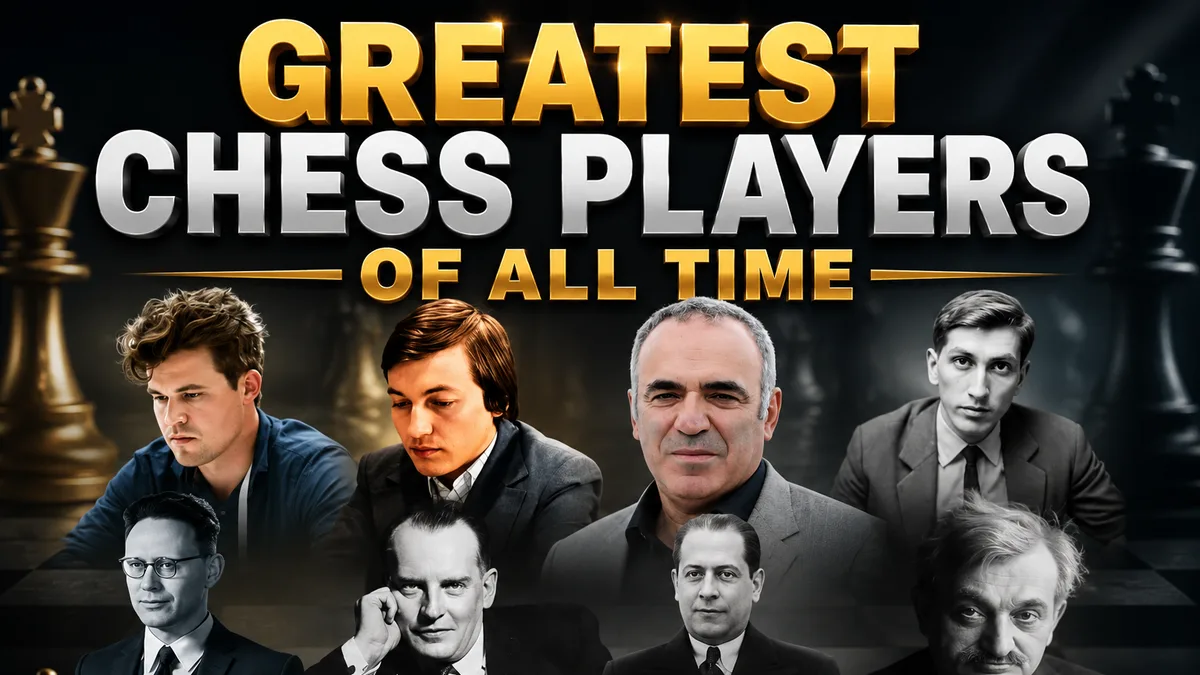
Ask ten players who the greatest chess player of all time is and roughly half say Garry Kasparov, half say Magnus Carlsen, and a stubborn minority hold out for Bobby Fischer. No committee settles it, which is why the argument never dies. The card ranking above is our read; the sections below explain how we got there and add the context the leaderboard leaves out.
How we ranked the greatest chess players
We leaned on three yardsticks, and no single one decides a case on its own:
- Length and margin of dominance against a player’s own contemporaries — the heaviest factor, because beating the strongest people alive for years is harder than a single rating spike.
- Peak Elo relative to the era, adjusted for the fact that ratings have inflated over time and pre-1970 fields were shallower.
- Lasting influence — openings, training methods, or ideas the rest of the field then had to answer.
Kasparov and Carlsen top the list because they score highly on the first two at once. Where a ranking is close — Kasparov over Carlsen, Fischer over Karpov — the tie breaks on sustained dominance rather than a one-off peak. If you want the money side of the modern game, our guide to chess prize money tracks what today’s elite actually earn.
Why comparing eras is hard
A raw Elo number is not a clean time machine. Ratings have drifted upward for decades as opening databases and engines raised the whole field’s baseline, so Carlsen’s 2882 and Lasker’s era-best figure are not measuring the same thing. Depth of competition matters too: a modern top-ten player faces dozens of 2700-rated rivals, while a pre-war champion might face a handful of genuine peers.
That is why we do not simply sort by peak rating. A champion who was head and shoulders above everyone alive — Lasker, Capablanca — can rank near a higher-rated modern player who had more company at the top. The women’s game runs on the same rating system; our list of the greatest female chess players applies these same measures to a separate championship lineage.
The champions the cards don’t cover
A few names sit just outside the ranking but shaped the modern game. Wilhelm Steinitz, the first official champion (1886–1894), invented the positional principles every later champion built on. Viswanathan Anand, a five-time World Champion, bridged eras — he beat Kasparov-generation rivals in the 1990s and was still a genuine title contender against Carlsen twenty years later. Alexander Alekhine, who ended Capablanca’s reign in 1927, is remembered for ferocious attacking play that contrasted sharply with the Cuban’s calm technique.
Champions at a glance
| Player | Country | World Champion | Case for greatness |
|---|---|---|---|
| Garry Kasparov | Russia/USSR | 1985–2000 | ~20 years at world No. 1 |
| Magnus Carlsen | Norway | 2013–2023 | Highest Elo ever (2882) |
| Bobby Fischer | USA | 1972–1975 | The 1972 “Match of the Century” |
| Anatoly Karpov | USSR/Russia | 1975–1985 | 160+ tournament wins |
| Emanuel Lasker | Germany | 1894–1921 | 27-year reign (record) |
| José Raúl Capablanca | Cuba | 1921–1927 | Near-flawless technique |
| Mikhail Botvinnik | USSR | 1948–1963 | Founded the Soviet school |
The modern era (2024–2026)
Today’s landscape is defined by a new champion and an old king who never left. Gukesh Dommaraju of India won the crown in December 2024 at 18, and his first defense is set for late 2026 against Uzbekistan’s Javokhir Sindarov, who won the 2026 Candidates Tournament with a round to spare. Yet the rating list still belongs to Carlsen, the only player above 2800 in 2026 despite having walked away from the title.
Behind them, Hikaru Nakamura, Fabiano Caruana, and India’s Arjun Erigaisi anchor the elite, while Alireza Firouzja and Sindarov headline a younger wave. With India, Uzbekistan, and the United States all producing top talent, the game’s power base is more spread out than at any point since the Soviet era. If the last few years hooked you on playing, our roundup of the best chess sets for fun is a good place to start.
Frequently asked questions
Who is considered the greatest chess player of all time?+
There is no official verdict, but the debate almost always narrows to Garry Kasparov and Magnus Carlsen, with Bobby Fischer as the popular third. Kasparov's case is roughly two decades as world No. 1; Carlsen's is the highest rating ever recorded and a decade as champion. Which you pick usually comes down to whether you value length of dominance or peak level more.
Who was the first World Chess Champion?+
Wilhelm Steinitz, an Austrian who later became a naturalized American, is recognized as the first official World Chess Champion. He held the title from 1886, when he beat Johannes Zukertort, until Emanuel Lasker took it from him in 1894. Steinitz also founded the positional, or scientific, school of chess — the idea that sound structure beats speculative attacks, which shaped every champion who followed.
What is an Elo rating in chess?+
Elo measures a player's strength from results against other rated opponents; win against stronger players and your number climbs. Above 2500 is roughly grandmaster level, and 2700 marks the super-grandmaster tier. The system, not the raw score, is what lets you compare players who never met over the board. As of 2026, Carlsen is the only player above 2800 on the FIDE classical list.
Who is the current World Chess Champion, and who will they face in 2026?+
India's Gukesh Dommaraju is the reigning champion after beating Ding Liren in December 2024, at 18 the youngest undisputed world champion ever. His first title defense is scheduled for late 2026 against Uzbekistan's Javokhir Sindarov, who won the 2026 Candidates Tournament with a round to spare. The match is provisionally set for late November into December 2026, with the host city still to be confirmed.
Why is Gukesh the World Champion if Carlsen is the world No. 1?+
They measure different things. The World Championship is a single knockout-style match, won in 2024 by Gukesh; the No. 1 ranking is your Elo across all rated games over time, still led by Carlsen. A champion can hold the title while sitting behind others on the rating list — Carlsen even stopped defending the crown in 2023 yet remains the top-rated classical player in 2026.
How does someone become a chess grandmaster?+
To earn the Grandmaster (GM) title, a player must score three GM 'norms' — strong results in qualifying international tournaments — and reach a peak rating of at least 2500. It is the highest lifetime title FIDE awards, and once earned it is held for life regardless of later rating drops. Roughly 2,000 players worldwide hold it, a fraction of one percent of rated competitors.
Sources
Play & tools
Free browser games and tools — no account, no download.
- Play today's Sports Connections — Today's Sports Connections — daily hints, answers, and play the grid.
- Play Guess the NFL Player — A new mystery NFL player every day. Eight guesses, with a clue on each — plus free unlimited mode.
- Explore all our games →
Related chess guides
View all →
Greatest Female Chess Players of All Time: Ranked
The greatest female chess players ranked — Judit Polgar, Hou Yifan, Ju Wenjun and the champions who built women's chess, with the record behind each pick.
Top Female Chess Players in the World Today
The top female chess players in 2026 by FIDE rating: Hou Yifan leads Lei Tingjie, champion Ju Wenjun, Zhu Jiner and Bibisara Assaubayeva. Ranked with ratings.
Greatest Female Baseball Players in History
The greatest female baseball players, from All-American Girls League pioneers to modern standouts like Marti Sementelli and international stars.

Greatest Lacrosse Players of All Time
From Jim Brown to Paul Rabil, these are the greatest lacrosse players in history — ranked by dominance, legacy, and impact on the sport.
Best Pool Players of All Time: The Greatest in Billiards
The greatest pool players of all time include Efren Reyes, Earl Strickland, Ralph Greenleaf and Shane Van Boening — ranked by world titles, U.S. Open wins and longevity at the top of the pro game.
Best Volleyball Players of All Time: The Greatest Ever
A ranked look at the greatest volleyball players in history, covering legendary setters, outside hitters, and blockers who defined the sport across decades.